

Credentials Without Outcomes
What Higher Ed Gets Wrong About Non-Degree Credentials—and How Need Finding Changes the Equation


The Solution Trap: A Guide to Better Decision-Making for Higher Education Leaders is available now. Get your copy here.
For years, higher education has been sold on a vision of innovation and growth through non-degree credentials. Short courses. Certificates. Digital badges. Microcredentials.
The idea is straightforward: to stay competitive in a changing marketplace, institutions need to diversify, find new revenue streams and markets, and meet learners where they are with credentials that are faster, cheaper, and more directly tied to workforce demand.
The credential marketplace has expanded rapidly in recent years—reaching more than 1.85 million unique offerings from more than 134,000 providers, according to Credential Engine’s Counting Credentials 2025 report.
But adoption and value are not the same thing. What does the evidence say about whether any of these credentials are actually moving the needle for learners and delivering real outcomes?
A June 2025 report from the Burning Glass Institute and the American Enterprise Institute, Holding New Credentials Accountable for Outcomes, drawing on more than 23,000 programs and 65 million career records, found that only one in eight non-degree credentials delivers material wage gains that earners wouldn’t have seen otherwise.
One in eight. That’s sobering. But it is also, at face value, just a number because behind every data point is a learner who paid real money, gave up real time, and expected a real return.
Meet Jenny
Jenny is thirty-eight years old. She works in administrative services at a mid-sized logistics company in the Midwest and has spent the better part of a decade watching colleagues move into analyst roles she has been quietly angling toward. Her performance reviews have always been strong. But without a credential to signal readiness for something more technical, she keeps running into the same invisible ceiling—the kind nobody names out loud but everyone understands.
So when a regional four-year university she knew and loved advertised a Data Analytics Certificate—fully online, designed for working professionals, twelve weeks, $1,800—she felt something she hadn’t felt in a while. The sense that maybe this was the opportunity she needed. A credential from a reputable institution that would finally make visible what she already knew she was capable of.
She enrolled, paying $1,800 out of her own pocket—not from a professional development budget or with employer support, but from her checking account. She told her husband she needed Tuesday and Thursday evenings for three months. She got up early some mornings to finish assignments before her kids woke up.
The curriculum was substantive. Over twelve weeks, she learned:
Statistical process control and the basics of quality management
Tools of data analysis—crossover analysis, break-even analysis, cluster analysis, and decision tree analysis
How to use statistics as a managerial tool
How to represent data graphically and make recommendations based on quantitative reasoning
What the program never taught her was SQL. Or Python. Or Tableau. Or how to pull data from a live database, clean a messy dataset, or build a dashboard that a hiring manager could actually use on Monday morning.
Of course, she had no way of knowing any of that was missing. The certificate said Data Analytics. The university marketed it as a pathway to a better job, and she had every reason to believe them.
Eventually, Jenny updated her resume and started applying to those jobs. Six months later, she is still in the same role, having applied for over 40 and hearing back from only two.
Every interview ended the same way. The certificate helped, but she also needed to demonstrate:
SQL proficiency
Experience with Tableau or Power BI
The ability to write Python scripts for data cleaning
Hands-on experience working with real business datasets
Jenny had done everything she thought she was supposed to do. The program just wasn't built around what she actually needed.
A Solution in Search of a Problem
The university Jenny attended didn’t set out to fail her. At some point, I imagine, a dean, a vice provost, or a faculty member looked at the changing landscape and saw an opportunity to do something new. Enrollment pressures. Revenue gaps. Evidence of a rapidly growing credential marketplace. All of it pointed in the same direction.
If you have ever been in the room when these kinds of opportunities are discussed—feeling the pull between moving fast and getting it right, sensing that something about the momentum isn’t quite right but not knowing how to slow it down without looking like you’re standing in the way—you know how it happened.
In The Solution Trap, I call it the lure of “Close Fast.” Under pressure, the first plausible solution that comes to mind fills the room. Questions that would have slowed things down never get asked, not because the people involved were careless or incompetent, but because the urgency of the moment left no room for questions.
I suspect that’s a lot of what we’re seeing in the Burning Glass/AEI report, and it’s a perfect example of Close Fast at scale.
Institutions developing non-degree credentials not because anyone deeply understood the specific problems learners were trying to solve, but because the pressure to innovate was real, the solution was visible, and moving fast felt like leadership.
Before You Build
Uri Levine, co-founder of the popular navigation app Waze, has a rule for starting any innovation project:
First, fall in love with the human problem…
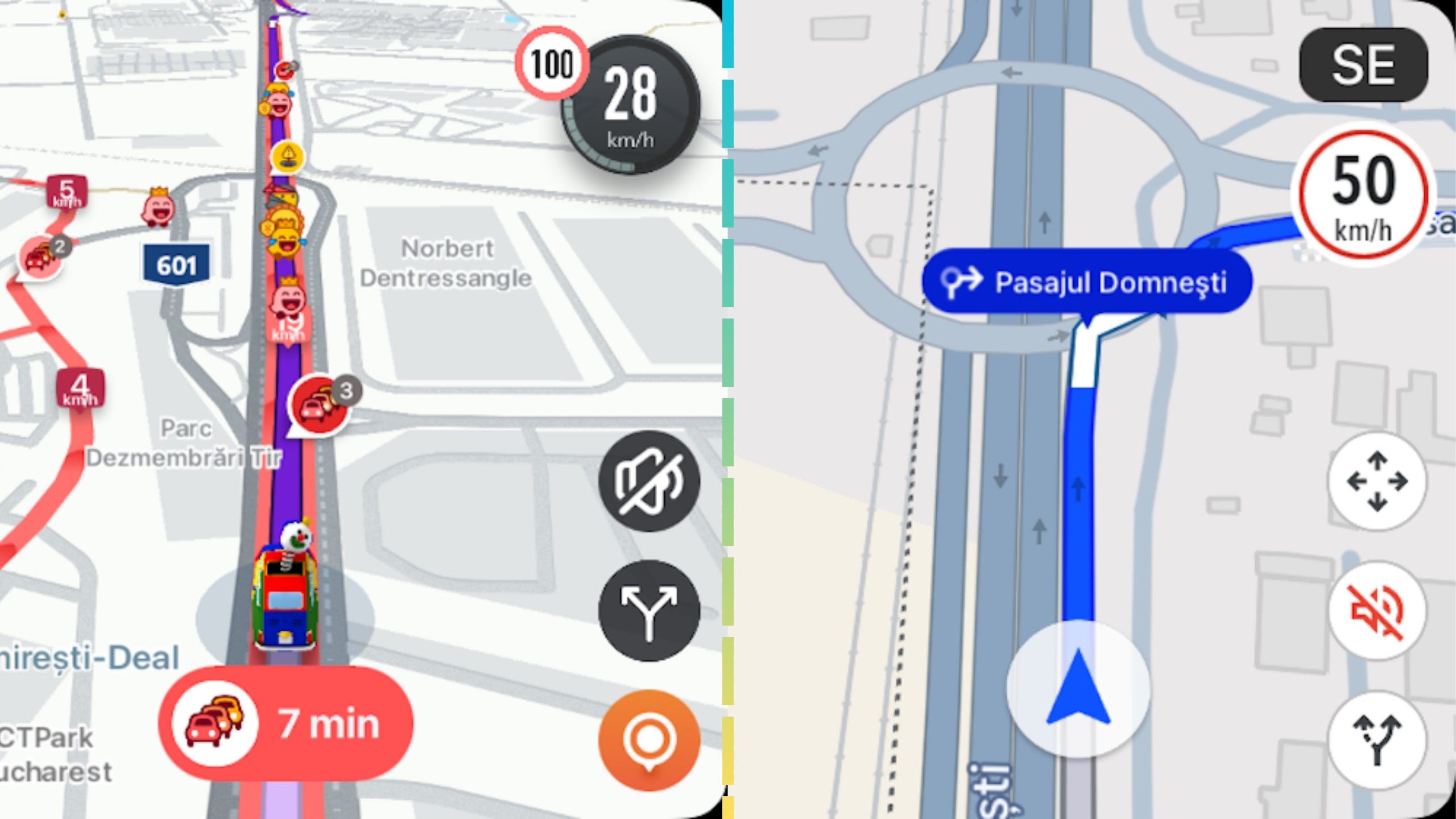
Waze didn’t succeed because it was clever technology. It succeeded because Levine and his design teams started with a problem millions of people face every day: the creeping anxiety of being stuck in traffic, watching the clock, knowing exactly where you need to be, and feeling powerless to get there.
What is Need Finding?
Waze didn’t start by building a better version of Google Maps. Waze started by understanding the specific frustration of the person behind the wheel, and the solution emerged from that understanding.
More concretely, Waze developers applied a human-centered design discipline known as need finding. Starting not with solutions but with the frustrations people actually live with, in the specific environments they actually inhabit.
Need finding is the discipline of understanding the problem a person is actually trying to solve before deciding how to solve it. Not the institutional version of the problem. Not the version that surfaces in a planning meeting, or market analysis, or a conference presentation. The human version of the problem—the specific frustration, in a specific life circumstance, that a solution either addresses or doesn’t.
Introducing the Need Finding Canvas
Need finding is not a complicated practice. It does not require a research team or a six-month discovery process. It only requires a genuine commitment to understanding the human problem before committing to a solution.
For non-degree credentials, this means answering a specific set of questions about which needs these credentials meet before a single course is designed or a single dollar is spent on marketing.
Questions like:
Who specifically is this credential for, and what problem are they (the learner) trying to solve?
What do employers in this specific labor market actually require for the roles these learners are targeting?
Does this program close the gap between where our learners are and where employers need them to be?
How will we know if these credentials work?
I’ve organized these questions into a simple canvas, a one-page tool developed specifically for higher education leaders and scholar-practitioners who need to understand lived experience before deciding how to proceed.
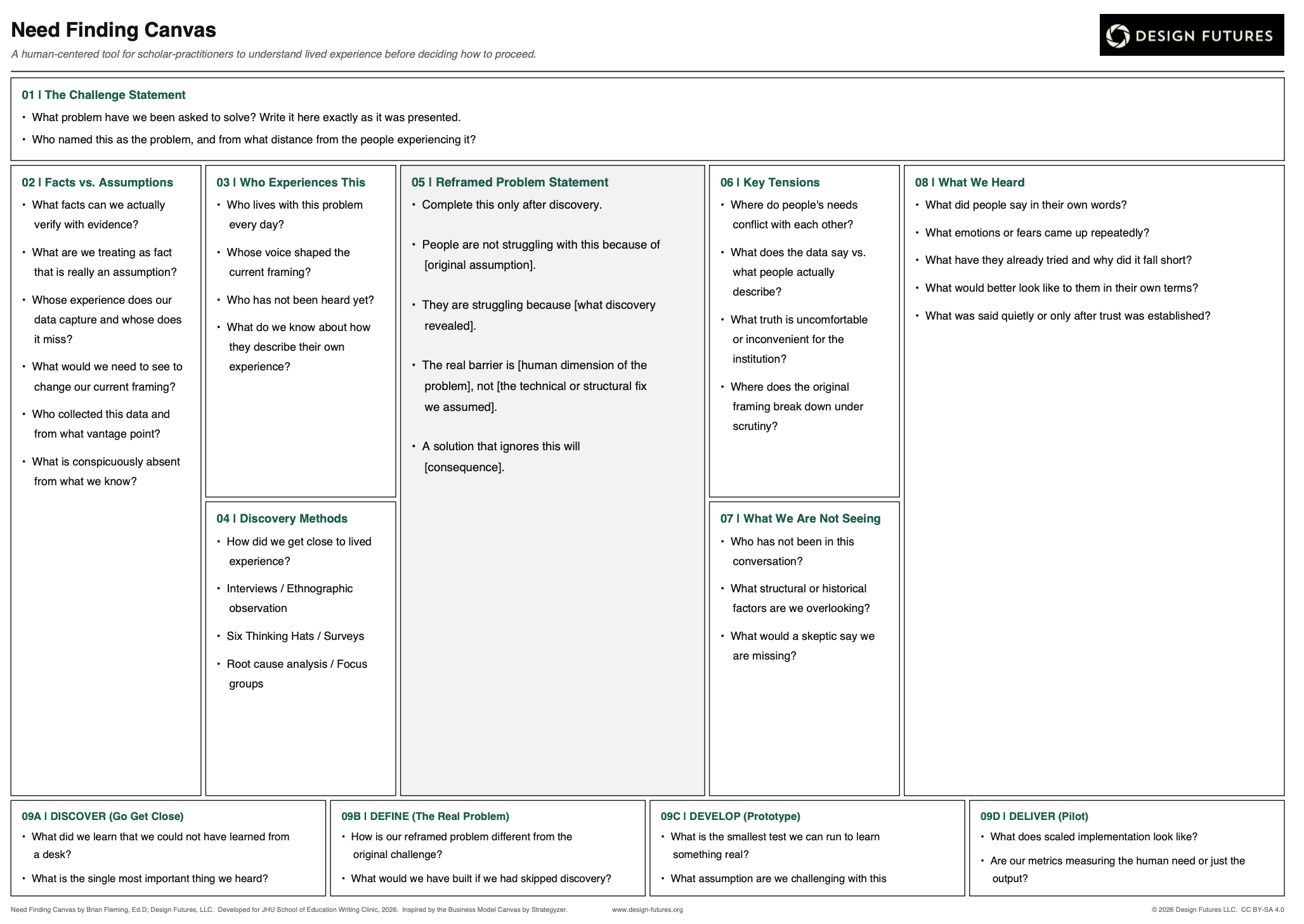

The canvas moves through nine blocks, starting with the challenge as originally presented and ending with a pilot that measures human need rather than output alone. Everything in between is discovery—getting close enough to the problem to understand it before committing to a solution.
The heart of the canvas is Block 05, the Reframed Problem Statement. The only rule is simple: don't complete it until after discovery. Everything that comes after depends on getting that step right.
So, What Problem do Non-degree credentials Actually Solve?
It’s a question I get asked a lot, and one I’ve spent considerable time thinking about in workshops and conversations with higher education leaders across the country.
Here is how I approach it through a need-finding lens.
Who is this credential actually for? Not the demographic profile—working adults, career changers, mid-career professionals. Those are abstract categories, not people. The real question is more specific:
What is this particular learner trying to do
What is standing in their way
What would it take to move them from where they are to where they need to be?
That question is harder to answer than it sounds. It requires getting up close and personal with the people the credential is meant to serve, talking with them, and understanding their specific situation in relation to the labor market and the employer landscape. It requires, in short, the kind of discovery work that most institutions skip when the pressure to build is high and the solution already seems visible.
Once you understand the learner’s problem with that level of specificity, then factor in the institution’s needs.
Revenue
Relevance
Market positioning
Those are real needs. But a credential that solves an institution’s revenue problem without solving the learner’s economic mobility problem is not a credential worth building.
Higher education has built an enormous non-degree credential marketplace. The question now is whether we’re willing to do the harder work of making that marketplace worth something to the learners we’re trying to serve.
Start with the learner. The institution’s needs will follow.
The Solution Trap: A Guide to Better Decision-Making for Higher Education Leaders is available now. Get your copy here.