

Designed to Grow
The Organizational Model Behind the Mega-U


Higher education leaders have spent years asking whether online education can become a meaningful engine of institutional growth. The Mega-U answers that question, but not in the way most of us imagine. The real innovation isn’t online learning. It’s organizational design.
In 2019, The Chronicle of Higher Education published a widely circulated article about a new class of institutions it called “Mega-Us.” At the time, I happened to be working for one of the institutions featured prominently in the article, and I’ll admit I had mixed feelings about the label.
On the one hand, “mega” suggested these institutions were somehow bigger than everyone else. But American higher education has never lacked big institutions:
Public flagship universities that enroll tens of thousands of students every year.
Community college systems that educate hundreds of thousands more.
Statewide university systems that have served large student populations across vast geographies for decades.
Researchers have even developed an entire body of scholarship around this phenomenon, commonly referred to as the “massification thesis,” describing the long-term expansion of higher education from an elite system serving a relatively small segment of society to one characterized by broad public participation.
On the other hand, “mega” implied these institutions had discovered some novel way to expand access. But expanding access has been one of higher education’s defining ambitions for generations—from the land-grant movement to the rise of community colleges, extension education, the for-profit sector, dual enrollment, and competency-based education—all examples of colleges and universities experimenting with new institutional models designed to reach more learners.
So if the Mega-U is not distinctive simply because of its size or its ability to expand access, what exactly sets the model apart?
Growth as an Institutional Strategy
Southern New Hampshire. Western Governors. Liberty. Arizona State. At first glance, these institutions appear to have very little in common.
Southern New Hampshire University was once a small private college in New England that nearly closed its doors before reinventing itself around online learning.
Western Governors University didn’t even begin as a university, but as a coalition of governors looking for new ways to connect higher education and workforce development.
Liberty University grew from a small Baptist college into one of the largest universities in the country through an early commitment to distance learning and continuing education.
Arizona State University followed yet another path, building one of the nation’s largest online enterprises while remaining a leading public research university.
Different histories.
Different missions.
Different governance models.
Different origin stories.
And yet, despite those differences, they all converged on the same solution to the same problem: how to build an institution capable not just of growth, but sustained growth.
A Mega-U is an academic enterprise designed to sustain growth by aligning every major institutional function around a common strategy.
Today, the institutions most commonly associated with the Mega-U educate more than 1.1 million fully online learners. For context, that’s roughly one in every four students enrolled exclusively online in the United States.
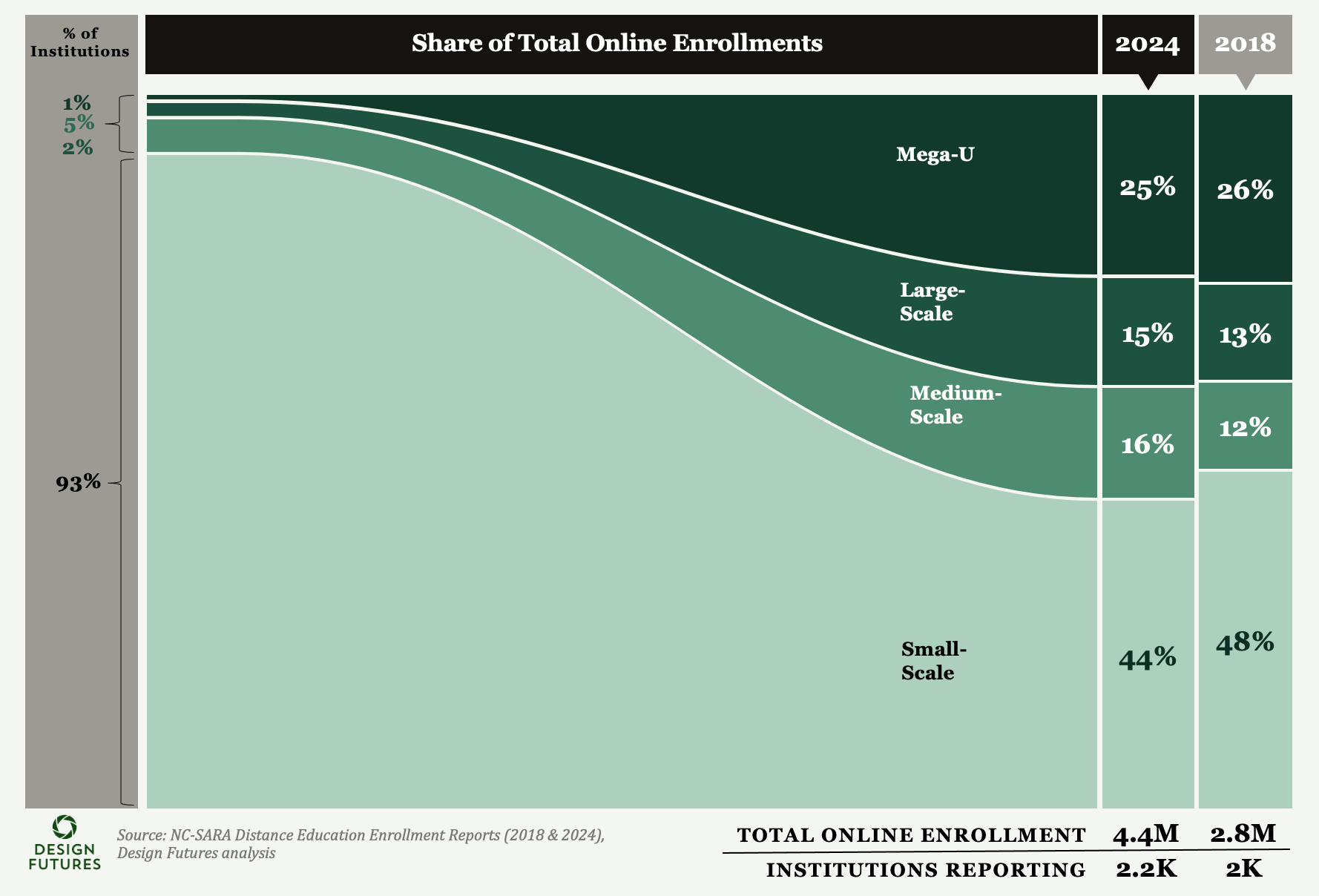
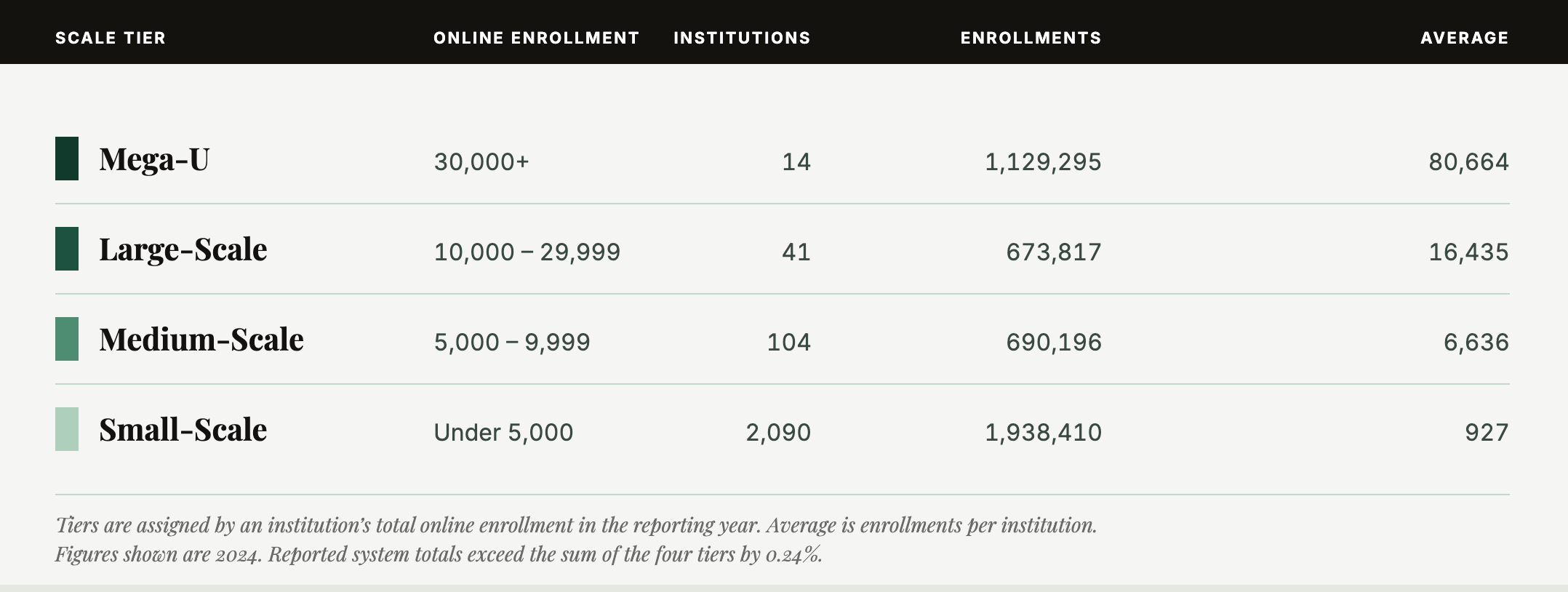
The size of these institutions, however, is only part of the story, because their success over the past decade has fundamentally reshaped the competitive landscape, concentrating a remarkable share of online enrollment among a surprisingly small number of institutions.
The obvious conclusion—and, I suspect, one a quick reading of The Chronicle article might encourage—is that these institutions simply became very large because they invested early and aggressively in online education. And that’s true, but also incomplete.
The more interesting question, one I’ve spent years trying to answer, is why such a small group of institutions (14, to be precise!) with such different histories, missions, governance structures, and organizational cultures has managed to command such an outsized share of this market.
The answer has surprisingly little to do with online education at all. It’s that a small group of institutions solved one of the oldest management problems in the book:
How to keep growing without the organization itself becoming the thing that holds growth back.
How the Mega-U Grows
If you want to understand how a small group of institutions came to educate roughly one in every four fully online learners, don’t start with marketing, enrollment management, technology, or even their commitment to access and student success.
Start with organizational design.
The Mega-U is an academic enterprise designed for growth.
Think about it. Many universities have expanded their online presence over the years by launching new programs, entering new markets, increasing marketing investment, and strengthening enrollment management. All can produce meaningful results, but in most cases they remain additions to an otherwise traditional institution, with an underlying operating model designed for a traditional student and a different definition of scale.
“Online growth” becomes something the average university pursues (usually for revenue generation) rather than something the university is designed to support.
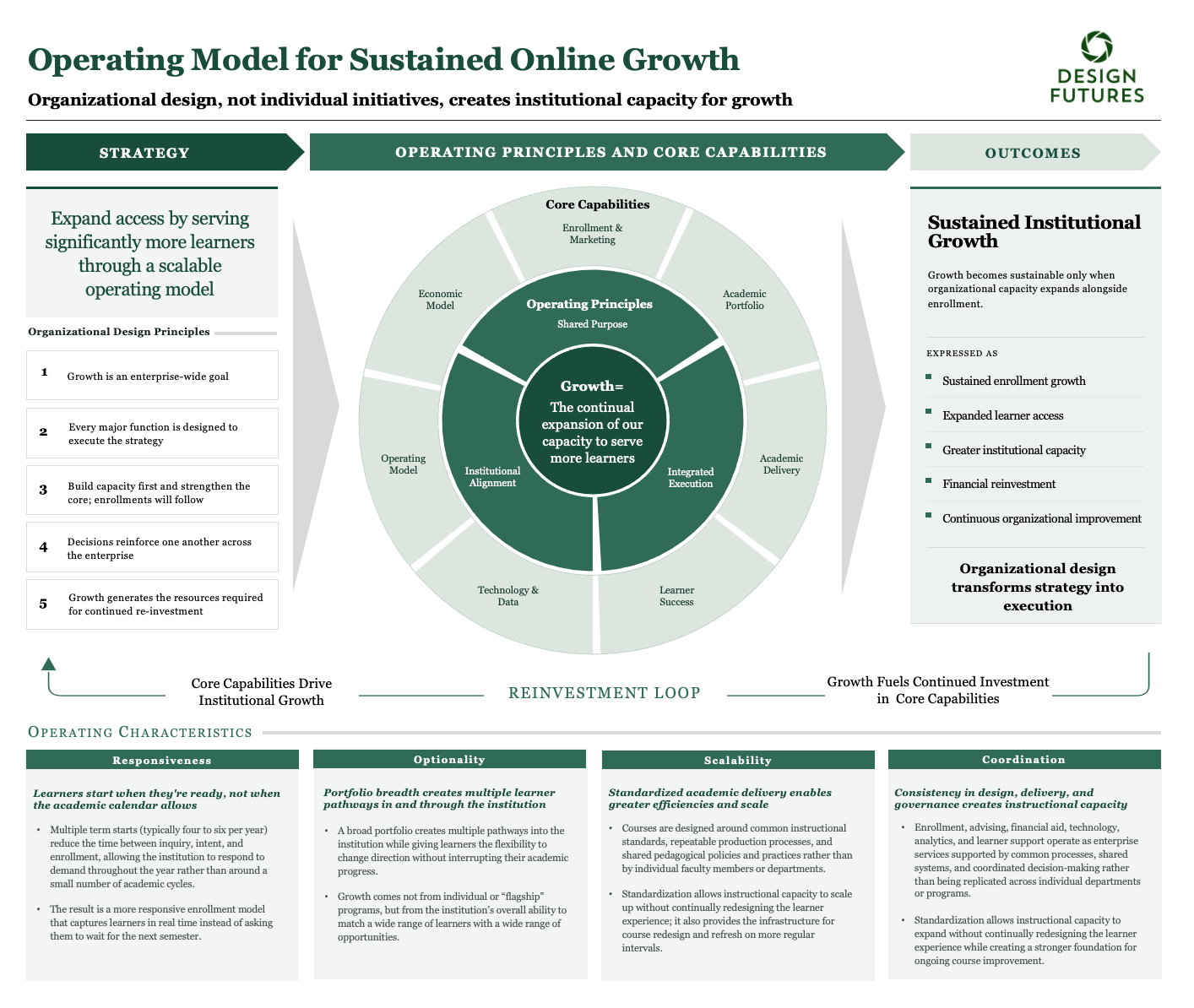
The Mega-U represents a fundamentally different model. Growth is an organizational design principle and problem to be solved with every major function of the institution intentionally organized around expanding capacity to serve more learners.
In other words…
Enrollment and marketing generate demand.
The academic portfolio creates new learner pathways.
Academic delivery absorbs additional enrollment.
Learner success improves persistence, lowers student acquisition costs, and improves the bottom line.
Technology connects information and workflows to improve the student experience.
Finance reinvests in the next stage of growth.
Individually, none of these functions enables the Mega-U to grow, per se. It’s when they operate together that they create the conditions for an institution to execute a growth strategy that sustains growth year after year.
Organizing Around the Strategy
The best academic theories are not always the ones that teach us something new, but rather that give us language for something we’ve observed all along without ever being able to fully explain.
I first encountered the work of organizational theorist Jay Galbraith, one of the pioneers of modern organization design, while working at the institution I described above. At the time, I wasn’t looking for some grand theory of online growth. I was just trying to understand why this remarkable institution operated so differently from every other university I knew—and more specifically, why it had become so good at sustaining growth year after year despite the same demographic, economic, and political headwinds facing the rest of higher education.
In his often-cited book Designing Organizations, Galbraith argued that organizations successfully execute a strategy only when their organizational design supports it. If growth is the strategy, then everything that follows—structure, processes, people, rewards, information, and decision-making—has to be intentionally organized around that single objective.
Strategy is not executed by a single department, a single technology platform, or a single successful initiative. It is executed by the institution as a whole.
Galbraith illustrated this relationship through what became known as the Star Model, a framework showing that strategy succeeds only when an organization’s major design elements reinforce one another.
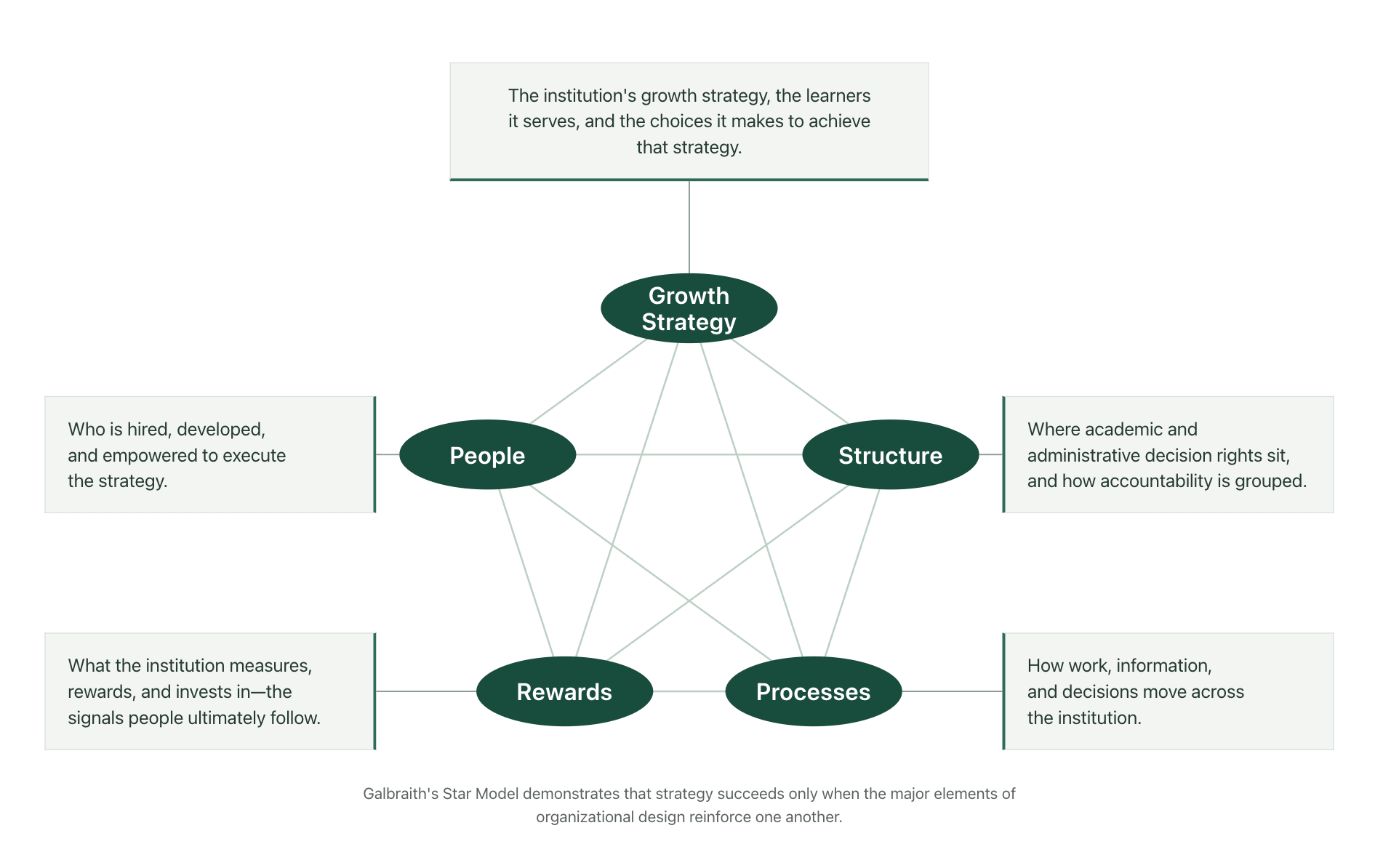
I didn’t appreciate it at the time, but the Star Model would soon become one of the most useful tools I had for explaining how the Mega-U works.
The Five-Dollar Tour
We jokingly called it the “five-dollar tour.” Every few weeks, groups of presidents, provosts, trustees, and strategy teams from other colleges and universities would spend a day on campus trying to understand how the Mega-U actually worked. After reading Galbraith, I began approaching those visits very differently.
One visit has stayed with me all these years later.
We hosted a leadership team from a large private university considering a significant investment in online learning. Like many institutions, they had seen some success online but were struggling to understand what it would take to move beyond a handful of successful programs. As we walked the halls, we stopped in various offices so members of the visiting team could hear directly from leaders across the university before gathering everyone for a final discussion.
To keep the conversation focused, I asked every colleague the same question:
Think about one student you’re serving today in your own area—marketing, advising, instructional design, or wherever you happen to work. What has to happen elsewhere in the institution for that student to succeed?
The answers were remarkably consistent.
Nobody described the work of a single office. Every answer quickly expanded to include the rest of the institution.
Marketing talked about generating demand, but only because the academic portfolio offered enough breadth to create meaningful pathways for prospective learners.
Admissions talked about bringing in more students each term, but only because online courses and programs had already been designed to absorb additional demand.
Learner success described persistence as the product of advising, technology, data, and operational processes working together to support timely intervention.
Finance talked less about budgets than about continually reinvesting resources into the capabilities that strengthened the institution and improved the student experience.
What stood out wasn’t the content of the answers, but how consistently my colleagues understood their own work in relation to everyone else’s. Every answer began with one office and ended with the institution.
As we wrapped up, one of our guests paused, looked around, and said something I’ll never forget.
“This place is an operational marvel. I’ve never seen anything like it.”
He was exactly right. And the longer I reflected on that conversation, the more I realized he had put words to something I had been trying to understand myself.
Growth by Design
The Mega-U demonstrates that a university can grow dramatically through online education. That’s an important lesson, but not the one I think matters most.
The more enduring lesson is that the Mega-U’s greatest innovation isn’t a technology platform, a marketing strategy, or even a particularly effective approach to online learning. Rather, it is that
Organizational design in higher education can itself be a strategic capability.
Read almost any university’s strategic plan, and you’ll find remarkably similar ambitions:
Larger enrollments
Stronger employer partnerships
Improved learner outcomes
New markets
Additional revenue through online education.
Ambition isn’t the difficult part; it’s building an institution capable of execution.
Viewed through that lens, investing in online education becomes a fundamentally different conversation that does not start with marketing, enrollment management, instructional design, technology, learner support, or even new academic programs.
Those investments all matter, but they are downstream of a much more fundamental investment in the organizational design required to align every major function of the institution around a common strategic objective.
And no, not every institution should aspire to become a Mega-U. In fact, in today’s market, with a relatively small number of institutions already educating a disproportionate share of online learners, simply replicating that model is unlikely to be a winning strategy anyway. The more valuable lesson is understanding what kind of institution your strategy actually requires you to build.
In my experience, that conversation almost always begins with asking better questions at the outset of the strategic planning process.
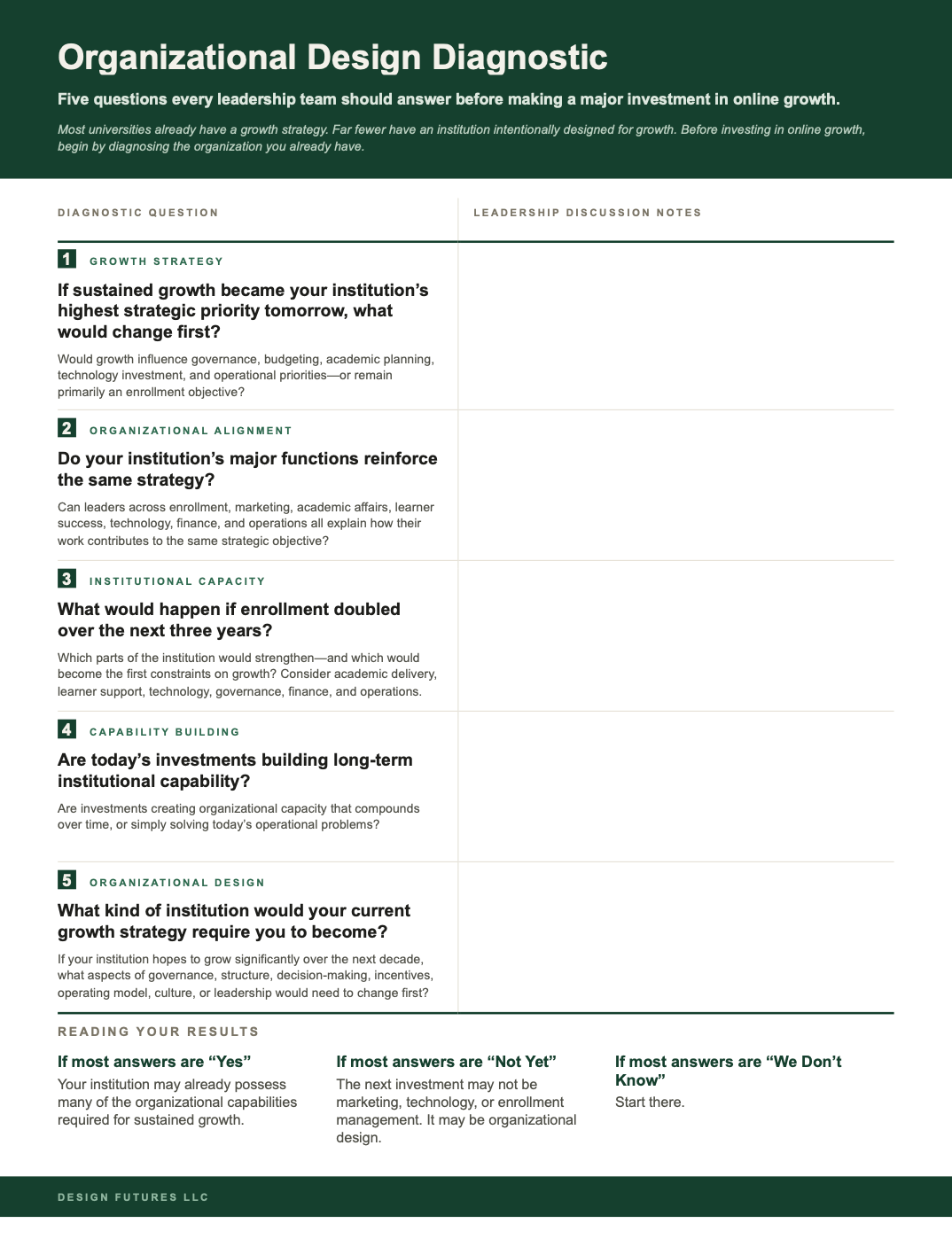
Before discussing marketing plans, technology platforms, enrollment targets, or new academic programs, I now encourage leadership teams to step back and ask a more fundamental question:
Is our institution designed to support the kind of growth we hope to achieve?
Below is a quick diagnostic I often use with presidents, boards, and senior leadership teams to begin that conversation.
Perhaps that’s the real contribution of the Mega-U. Not proving that universities can grow through online education, but reminding us that sustained growth has always been an organizational challenge before it is a technological or enrollment challenge.
The Mega-U teaches us that growth is not something an institution achieves but something it’s intentionally designed to support.
Further Reading and Helpful Resources
The ideas in this article draw on the work of several scholars and organizations that have shaped my thinking on strategy, organizational design, and online higher education. If you’d like to explore these ideas further, I’d recommend starting here.
The Chronicle of Higher Education. “The Rise of the Mega-U” (2019).
The article that first introduced the term Mega-U and inspired many of the questions explored in this essay. While the Chronicle documented the emergence of these institutions, this article seeks to explain why they grew as they did.
Jay R. Galbraith. Designing Organizations: Strategy, Structure, and Process at the Business Unit and Enterprise Levels.
Galbraith’s work on organizational design became the theoretical foundation for this article. His argument that organizations execute strategy only when structure, processes, people, rewards, and decision-making reinforce one another fundamentally changed the way I thought about the Mega-U.
National Council for State Authorization Reciprocity Agreements (NC-SARA). Distance Education Enrollment Reports.
NC-SARA publishes one of the most comprehensive annual snapshots of online enrollment in the United States. The enrollment figures and market concentration data referenced throughout this article come from these reports.
McKinsey & Company. “What Is an Operating Model?”
One of the clearest executive-level explainers I’ve found on operating models and organizational design. Although written for a broad business audience, many of the concepts translate remarkably well to colleges and universities thinking about strategy execution.
Clayton M. Christensen. The Innovator’s Dilemma.
Although this article is not about disruptive innovation, Christensen’s work remains essential reading for understanding why established organizations often struggle to respond to structural change, even when they recognize the need to do so.