

Direction, Alignment, and Commitment
The Hard Work of Making Decisions Together


One of the most important questions in organizational decision-making is also the easiest to overlook:
What does success look like?
Most of us assume we already know the answer. After all, if the people around us support an initiative, surely we share a common understanding of where it is supposed to take us, right?!?
In my experience, that assumption is usually where we go wrong. And it’s one of the reasons I spend so much time discussing this practice in my latest book, The Solution Trap.
Defining success is not about predicting the future with precision, nor is it about locking ourselves into a particular outcome. It’s about making our assumptions visible early on.
When we’re forced to describe success in concrete terms, differences in priorities, expectations, and desired outcomes often emerge while they’re still notional, manageable, and easy to discuss.
The Illusion of Agreement
Several years ago, I had the opportunity to present on this practice to a university leadership team at an off-site retreat. The session concerned a major strategic initiative that had been under discussion for months: a comprehensive partnership with a nearby community college system.
I handed each member of the group an index card and asked a simple question:
“What does success look like for this partnership three years from now?”
As the conversation unfolded, I started picking up on some interesting patterns:
People nodding enthusiastically as others shared their responses, but not at the same time.
Every time the conversation shifted to the financial benefits of the partnership, only one person chimed in (the CFO).
Discussions about transfer pathways, student outcomes, institutional visibility, and operational efficiencies all seemed to activate different parts of the room, at different times, and for what I perceived to be different reasons.
The exercise was revealing, to say the least. Each response was thoughtful. Each represented a legitimate aspiration for the partnership. Yet taken together, they all described very different, and even contradictory, futures for the university.
Enthusiastic team, for certain, but not aligned—and almost certainly heading down the wrong path.
Remember, outward agreement is not always evidence that your team is on the same page.
The Illusion of Unanimity
More than fifty years ago, Yale psychologist Irving Janis described a phenomenon he called the illusion of unanimity:
The tendency for groups to mistake the absence of visible disagreement for genuine agreement.
That’s exactly what I witnessed during the retreat. People nodding along, saying nice things, and generally appearing to support a major initiative.
Janis’s deeper insight was that this kind of “apparent” consensus can conceal assumptions that have never been fully examined.
Some viewed the partnership as a revenue growth strategy. Others saw an opportunity to extend the university’s mission. Some focused on operational efficiencies and administrative scale. Others were motivated by expanded access, stronger transfer pathways, or improved student outcomes.
Each perspective was reasonable. Each represented a legitimate institutional concern.
But they were not the same measures of success.
The issue was not that people saw things differently. The issue was that they had never fully clarified together what problem this partnership would solve.
When we define problems differently at the start of an initiative, we will eventually pursue different solutions.
The Missing Foundation
Most of us spend considerable time evaluating options. We compare vendors, review financial models, assess risks, debate timelines, and discuss implementation plans. All of that matters.
We spend far less time evaluating the quality of our agreement.
Before asking whether a solution is right, we need to ask whether we share a clear understanding of the problem to be solved. That work may feel slower at first, but it prevents us from building momentum around a decision that means different things to different people.
This is especially important in higher education because many of our most common strategic terms carry multiple meanings. Words like innovation, student success, access, affordability, partnership, digital transformation, and AI can create the appearance of understanding long before that understanding actually exists.
The better question is not simply, “Do we agree?”
It is, “What exactly are we agreeing to?”
That may sound like a subtle distinction, but it turns out to be one of the most important questions a leadership team can ask. Once we establish a shared understanding of the problem, a second question immediately follows: How do we know whether we are truly aligned around it?
Years ago, that question led me to one of the most useful leadership frameworks I have encountered.
Direction, Alignment, and Commitment: A Helpful Framework for Making Better Decisions
It all stemmed from the work of Wilfred Drath and his colleagues at the Center for Creative Leadership, whose research suggests that effective collective leadership produces three outcomes:
Direction: A shared understanding about what we are trying to create together.
Alignment: A shared understanding about how the effort fits together, who owns what, and how responsibilities connect.
Commitment: The willingness among a group to prioritize the shared direction, especially when competing priorities arise.
Returning to the retreat exercise, the index cards revealed, at best, a direction problem. People supported the initiative but described different futures. That’s what first caught my attention.
If the team had moved forward without addressing that gap, alignment would have been next to impossible. Sooner or later, disagreements about ownership, priorities, resources, and trade-offs would have surfaced.
Commitment almost certainly would have been tested later, when trade-offs arose. It’s one thing to support an initiative in principle; it is another to prioritize it when it requires money, staff time, political capital, or changes to how an organization operates.
In this sense, problem clarity is not separate from direction, alignment, and commitment. It is what makes all three possible.
Without shared understanding of the problem, direction fragments, alignment weakens, and commitment becomes conditional.
Looking Beneath Agreement
If direction, alignment, and commitment are the true test of decision quality, and I believe they are, we need to ask better questions before moving forward with major initiatives. The goal is not to eliminate disagreement. It is to surface differences early enough to examine them before they become obstacles down the road.
One way to do that is to treat direction, alignment, and commitment as diagnostic lenses rather than abstract leadership concepts. This framework becomes especially useful when we translate it into a set of practical questions.
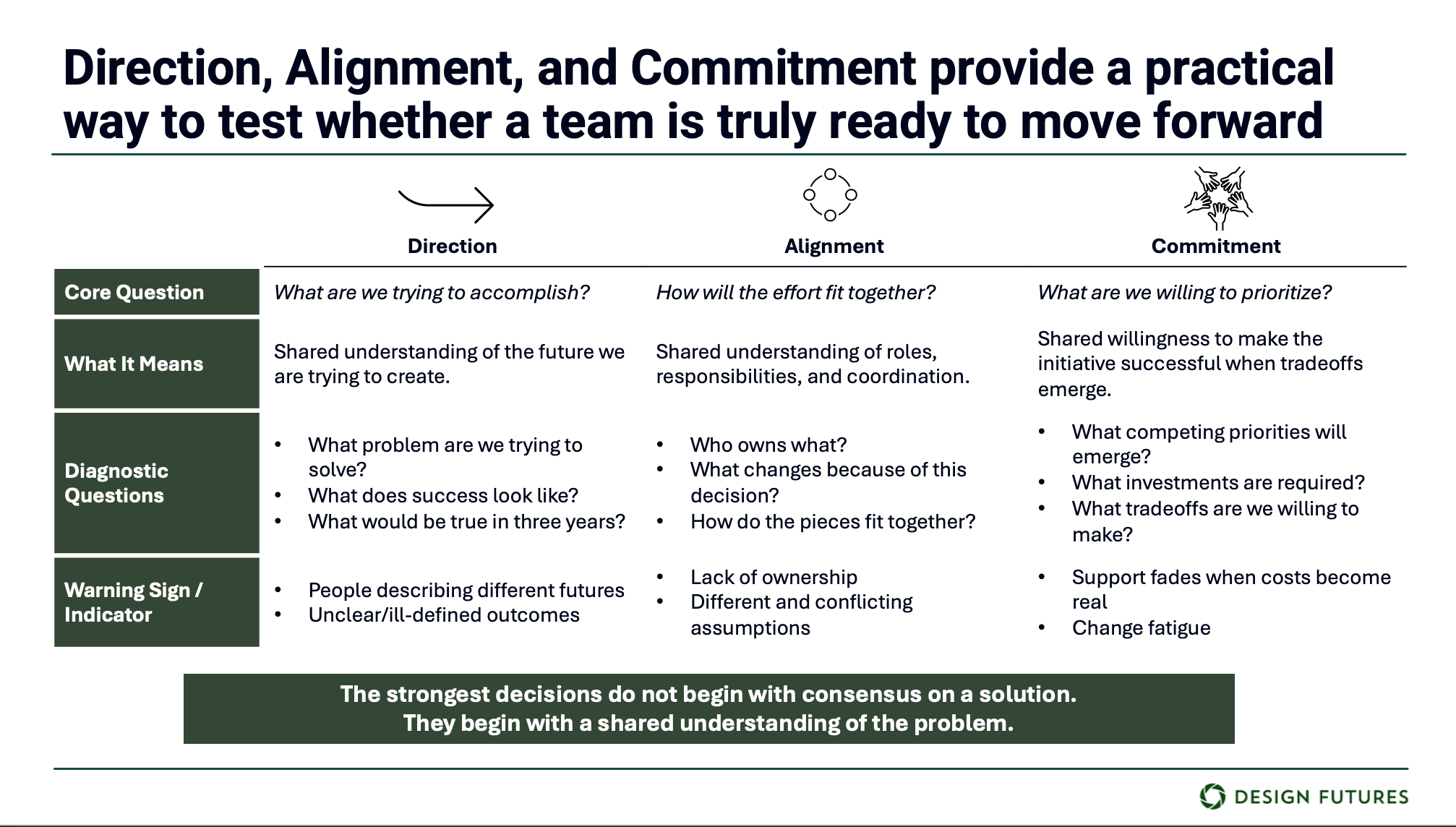
A team can survive moments of disagreement. What’s much harder to survive is discovering months later that everyone believed they were agreeing to very different things.
The Bigger Question
When initiatives struggle, we often focus on what went wrong at the execution phase. We ask whether the strategy was flawed, whether implementation was effective, or whether the right people were involved. Sometimes those explanations are correct.
But sometimes the problem begins much earlier.
Sometimes, we may find that we never developed a shared understanding of the problem in the first place.
When that happens, the consequences may not be immediate. Direction seems clear until competing visions emerge. Alignment seems strong until responsibilities overlap or conflict. Commitment seems solid until difficult trade-offs reveal what people truly prioritize.
The lesson is not that leadership teams should avoid disagreement. In many cases, disagreement is exactly what we need because it brings assumptions to light. The more important lesson is that agreement alone is not a reliable indicator of decision quality.
Before we ask whether we have direction, alignment, and commitment, we should ask a simpler question: What problem are we trying to solve?
The strongest decisions begin not with agreement on a solution, but with shared understanding of the problem.
Sources and Further Reading
Irving Janis, Victims of Groupthink (1972)
The foundational work on groupthink, including the concept of the “illusion of unanimity” that can cause groups to mistake apparent agreement for consensus.
Wilfred H. Drath et al., “Direction, Alignment, Commitment: Toward a More Integrative Ontology of Leadership” (The Leadership Quarterly, 2008)
Introduces the Direction, Alignment, and Commitment (DAC) framework and argues that these three outcomes are the essential products of collective leadership.
Warren Berger, A More Beautiful Question (2014)
A compelling exploration of how better questions lead to better decisions, innovation, and organizational learning.