

Don't Misread the Middle
Change Always Gets Worse Before It Gets Better


Growth came quickly for this large private university.
Over five years, the institution’s online programs expanded dramatically, especially following the sudden shift to emergency remote instruction during COVID. By 2025, what had once been a small portfolio of online offerings had grown into a meaningful share of the institution’s overall enrollment, brand, and digital footprint.
As online learning moved from a peripheral activity to a central part of the institution’s academic and financial picture, leadership widely viewed that momentum as a success.
Financially, it was. Organizationally, it wasn’t.
As I advised the university’s leadership team at the time:
Organizational design is the problem. You were never built to support this kind of growth, in this market, and at scale. Your "success" has been achieved through decentralized, opportunistic expansion, which might have worked when online was peripheral, but will become unsustainable as online moves to the center of your business model.
The “Problem” Was Structural
The university was successful on many accounts. Programs performed well. Revenue followed. But the underlying structure revealed several problematic patterns:
No single leader or team “owned” online
Faculty assignments were negotiated unit by unit with little formal onboarding or training in online teaching
Course quality was uneven, and standards varied
Processes, even prices, differed widely across programs.
Addressing this required more than incremental fixes. The institution needed to commit time, talent, and financial resources to online education on a large scale, beginning with the creation of a standalone Division of Online Learning. The goal was coherence:
Shared standards
Repeatable processes
Clear ownership over the online student experience
The assumption—mine and theirs—was that once the decision was made, the institution would just...change.
As if structure alone could rewire decades of ingrained organizational behavior overnight.
That assumption was wrong. Once the new division was in place, things got worse!
Approvals that once moved automatically through self-contained systems slowed to a crawl. Requests that once took minutes bounced between offices as people tried to determine where authority lay. Staff reassigned to new roles were unsure where their decision-making authority began and ended. With each big decision, people hesitated—not out of resistance, but out of uncertainty.
From the inside, the change felt chaotic. From the outside, it looked like the institution was unraveling.
I watched it unfold in real time. The noise felt personal. Delays felt like defiance. Confusion registered as incompetence. Every unanswered question about what the new division was supposed to accomplish felt like a referendum on the decision itself.
Reversing course started to look like the responsible move, but it wasn’t.
When Things Fall Apart
Here’s what I’ve learned about big structural change: many necessary structural changes die at exactly this moment, and not because they were wrong, but because the disorder that follows gets misread as evidence of failure.
But the disorder isn’t random. It follows a necessary (and “messy”) pattern where:
Decisions that used to resolve themselves now escalate. Questions that departments once handled internally now rise to senior leadership. Issues that stayed local now require coordination across units. What felt manageable now feels cumbersome.
Problems surface together instead of staying separate. A decision in one area triggers questions in another. Fixing one thing exposes misalignment somewhere else. Issues that were once buffered from each other now collide. The organization discovers dependencies it didn’t know existed.
People hesitate because the new rules aren't clear yet. Staff who once acted with confidence now pause before deciding. Familiar processes no longer apply, but new ones haven’t been established. Authority is unclear. So people wait, escalate, or work around the ambiguity.
As the change takes root, the organization feels louder and less stable than before, not necessarily because the decision to centralize was wrong, but because problems that had always existed in the decentralized system are now visible.
The question isn’t whether the transition from decentralization to centralization will be hard. It will be. The question is whether you can resist the urge to mistake that difficulty for failure.
The Theory Behind the Chaos
What feels like an organization coming apart is often something else entirely.
More than forty years ago, the organizational psychologist Karl Weick described colleges and universities as loosely coupled systems. In our institutions, schools, departments, and programs are all “connected” but not tightly aligned. Coordination exists, but often works indirectly through shared professional norms, symbolic commitments, or political relationships rather than explicit directives.
Authority is present but exercised unevenly: a dean might control budgets but have little say over curriculum; a provost might set policy that departments quietly work around.
Loose coupling is not a flaw. It’s how institutions function. It allows complexity to be absorbed locally, decisions to settle through routine, and inconsistencies to coexist without constant central coordination.
Structural change disrupts that loose coupling.
Authority that had been distributed becomes centralized.
Routines that had been informal become formalized.
Exceptions that once smoothed over misalignment are questioned.
In other words, what had once been buffered becomes visible.
When loose coupling is disrupted, the change is not abstract. It shows up in how decisions get made, how problems surface, and how the organization feels day to day:
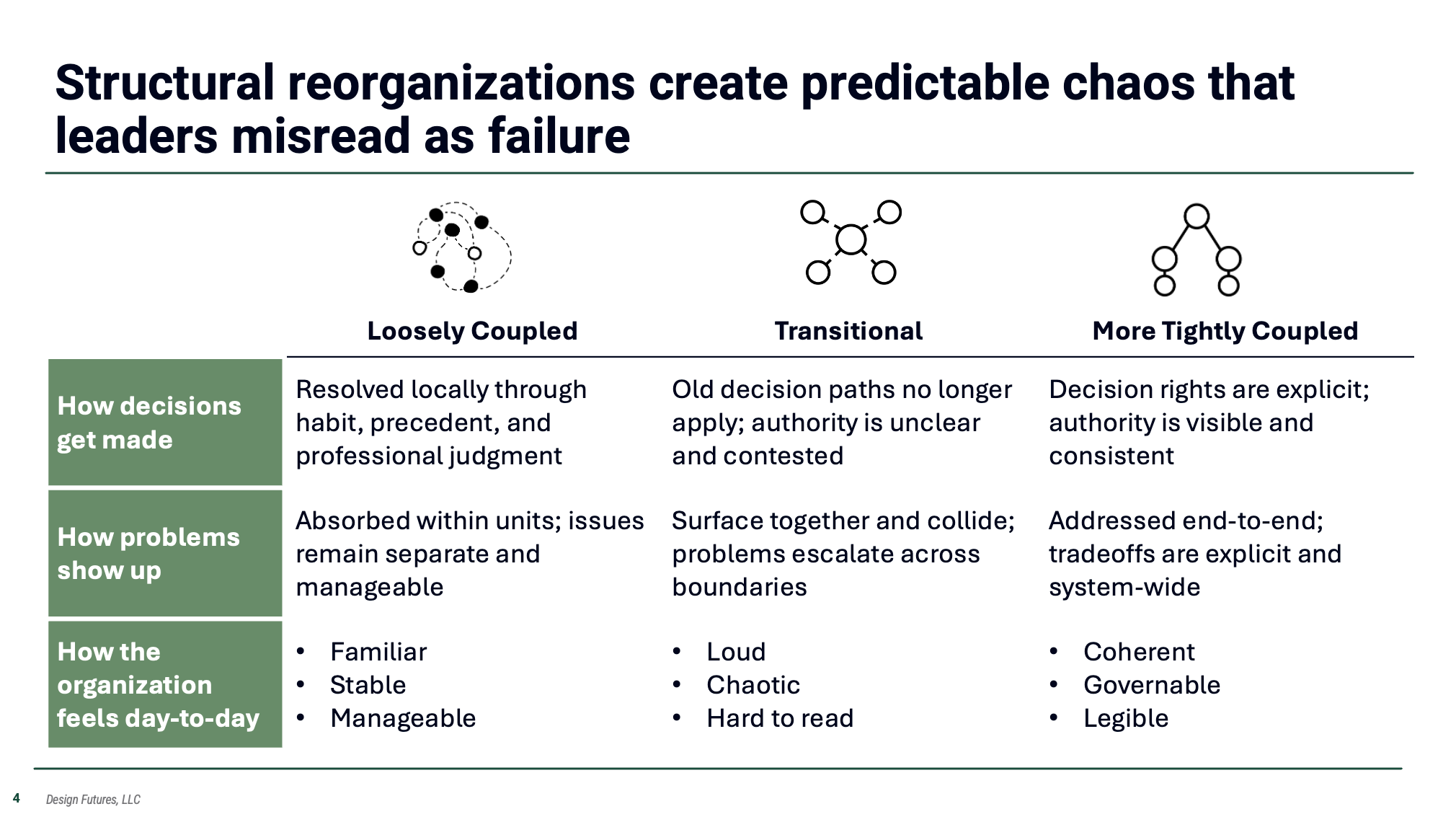
What is most unsettling about the transitional phase is not that the organization lacks direction; it’s that the usual cues that tell us something is off no longer work.
Decisions that once resolved themselves now demand attention.
Problems that once stayed contained now arrive together.
The organization feels louder not because it is failing, but because the mechanisms that once absorbed complexity no longer do.
According to Weick, nothing is broken. The organization is simply doing what loosely coupled systems do when their routines are disrupted.
What you’re witnessing is the natural and inevitable renegotiation of how better coordination actually takes shape. And yes, it’s “messy". That’s the point.
Just remember that the transitional phase is not the destination. It’s the necessary passage from one state of “coupling” to another: from a system that worked through informal routines and local judgment to one that works through explicit authority and coordinated processes.
The disorder is not incidental to the change; it is how the change works. You cannot redistribute authority without surfacing uncertainty. You cannot formalize routines without exposing dependencies.
The transitional phase is not a problem to be solved. It's the mechanism through which loose coupling gives way to tighter coordination.
The problem isn't that this transitional phase exists. It's how quickly we lose patience with it.
Reading the Middle
The middle will always feel loud. What matters is whether uncertainty is gradually redistributing back into the system, or continuing to concentrate at the center.
Whether new routines are beginning to take hold or whether exceptions are multiplying. Whether decisions are becoming more legible over time or less. This is where many of us struggle. We react to intensity rather than trajectory. We treat the volume of disorder as evidence. We confuse the discomfort of transition with proof that something has gone wrong.
The mistake isn't experiencing disorder after structural change. The mistake is believing disorder signals failure. Structural decisions that matter are always disorderly at first. The disorder is not incidental to the change. It is how the change works.
Reframing the Transition
Back to the university. Growth exposed an organizational reality that the institution could no longer ignore. The decision to create a Division of Online Learning was an attempt to respond to that reality, not to eliminate complexity, but to make it governable. And it was the right call for the institution, the faculty, and, most of all, the students.
Whatever disorder followed was not evidence that the decision failed. It was evidence that the institution had entered the hardest part of the transition.
Loose coupling kept things workable when online learning was small and peripheral. It was what allowed the institution to grow in the first place. Disturbing that arrangement was always going to be uncomfortable, but it was inevitable.
The noise that followed was not a detour from the change. It was the change.
Innovation doesn’t always “fail” because the initial decision was wrong. It fails because we lose our nerve in the middle, when routines collapse, uncertainty concentrates, and the institution feels hardest to manage.
The danger isn't disorder. It's mistaking disorder for failure and retreating before the institution has had time to become something new.
Brilliant application of Weick's loosely coupled systems theory to real organizational change. The table comparing pre-transition vs transitional vs post-transition states makes the theory actionable. I've seen this exact pattern play out with EdTech implementations where leadership panics during the middle phase and pulls back, essentially wasting resources. What seperates successful transformations is tolerance for productive ambiguity. The loose-to-tight coupling shift isn't instant; institutions that grasp this survive thransitions that others abandon prematurely.