

Learning to See the System
The Habit That Shapes Every Successful Consulting Engagement


Effective problem-solving begins by looking beyond symptoms to identify the constraints, relationships, and systems that shape organizational performance.
A few months ago, a senior university leader called me with a problem: a project that he was leading was beginning to drift.
His words, not mine: “We started strong, but now we’re struggling…and there’s no shortage of opinions on my team about what needs to happen next.”
I began spending time with the team, listening in on meetings, talking with stakeholders, and observing how decisions were being made, and it did not take long for some patterns to emerge.
Some leaders wanted faster execution. They felt the team was moving too slowly and worried the project would miss important milestones.
Others wanted the opposite. They believed the team was moving too quickly and without sufficient consideration for the institution’s mission, culture, and core responsibilities.
One person pointed to a lack of accountability (that comment definitely stood out), arguing that decisions were being made without enough consensus from across the institution.
Another believed the project simply lacked the staffing necessary to meet its objectives.
Several people complained about outdated technology and insufficient digital infrastructure.
Everyone seemed to have a different explanation for why progress had stalled.
As I listened to the conversation, I noticed a pattern that has become increasingly familiar over the years.
Nearly every comment focused on outcomes. People talked about deadlines, deliverables, adoption rates, participation levels, implementation timelines, and performance goals. They could describe the project's destination in remarkable detail. What they struggled to describe was the one thing preventing them from getting there.
Not the many things; that “one thing,” which, at first glance, I know may seem like an unreasonable thing to expect from a team already underwater. After all, colleges and universities are complex organizations. Multiple priorities compete for attention. Different stakeholders experience the institution in different ways. Rarely does a single factor explain everything.
Still, I’ve come to believe that the search for “that one thing” sits at the heart of every effective consulting engagement, which is why I always start there…
When Outcomes Become the Goal
Every organization has its own culture, history, and challenges. Over the years, I have worked with public universities, private colleges, nonprofit organizations, and startups, each with its own mix of opportunities and obstacles.
Despite those differences, I have found that organizations often fall into a similar trap—the solution trap—which, among other things, means becoming fixated on outcomes while paying less attention to the systems that produce them.
In some ways, this reminds me of Goodhart’s Law, a concept attributed to British economist and former Bank of England advisor Charles Goodhart. Writing in the 1970s, Goodhart observed a pattern that has since become a staple of economics, public policy, and organizational management:
Once a measure becomes a target, it ceases to be a good measure.
Applied, say, to a project, the pattern is all too common. We rally around metrics because they help us understand what is happening within a system, but eventually we stop treating metrics as signals of what needs to change and start treating them as the change itself. At that point, we begin continuously optimizing for the metric rather than for the underlying condition it was intended to represent.
Higher education is particularly susceptible to this. Enrollment targets, fundraising goals, retention rates, rankings, project milestones, and strategic objectives—all things that matter. But when our attention becomes so consumed by the outcome itself, we lose sight of the conditions producing it.
Over time, I have developed a habit that helps me avoid this trap.
Before discussing solutions, I try to understand the system.
Why I Always Start With Systems
Systems may sound abstract, but the idea is straightforward. Organizations are complex networks of people, incentives, processes, technologies, relationships, and decisions. Most of the challenges we face are not isolated events but rather the visible outputs of larger sets of variables operating exactly as they have been conditioned to operate.
That said, my interest in systems has never really been about org charts, governance committees, or process maps. It stems from my unwavering belief that every organization, idea, and innovation ultimately “scales” through the quality of human input, interaction, and iteration.
That distinction—the human lens—matters because I have never believed organizations scale through strategy alone. They scale through thousands of small human interactions: decisions, conversations, handoffs, judgments, disagreements, and acts of collaboration.
Systems matter because they shape how we experience that work. They influence where our attention is directed, how decisions are made, who feels empowered to act and who doesn’t, who leads change and who gets shut out, and whether talented people spend their time creating value or navigating bureaucracy.
When a system works well, people can focus their energy on meaningful work. When it does not, even highly capable teams struggle to make progress.
Every System Has a Constraint—Find That First
The fastest way I know to understand a system is to identify its constraint.
A constraint is the condition that most limits the performance of a system. Every organization has one, although it is not always obvious at first glance.
Sometimes the constraint is financial. The institution lacks the resources necessary to pursue its ambitions.
Sometimes the constraint is talent. The work requires capabilities that are not currently available to the organization.
Sometimes the constraint is technological. Systems create friction instead of enabling progress.
Sometimes the constraint is political. Stakeholder interests make change difficult even when the need for change is apparent and widely understood.
Sometimes the constraint is symbolic. Years ago, I worked with a New England college with a prominent but deteriorating colonial-era building right in the middle of campus. A sketch of the building was a beloved, longtime fixture of the institution's branding. Idyllic as it was, the building consumed significant financial resources to maintain and sat mostly empty, no longer serving a meaningful operational purpose. Yet removing it was almost unthinkable because it had become a symbol of institutional identity. The constraint, in this case, was not financial. It was symbolic.
Find the constraint, and the path forward usually becomes obvious. Miss the constraint, and even the best-intentioned recommendations will solve the wrong problem.
What—More like Who—Was Really Slowing That Project Down
At first blush, the project I described earlier appeared to be operating within a time constraint.
Some believed the project was moving too slowly. Others believed it was moving too quickly.
My recommendation could have been to speed things up or slow things down.
Instead, I dug deeper, and the more time I spent with the team, the more apparent it became that the project was not time-constrained at all. It was constrained by authority, specifically by the very person who hired me to help get the project “back on track!”
Decisions that appeared delegated were still being pulled upward. Team members waited for approval before moving forward. Meetings became places to revisit decisions rather than make them. Work slowed not because people lacked urgency but because the system required excessive coordination before anyone could act.
Competing priorities, duplicated effort, and frustration were all downstream consequences of that reality.
Ironically, the person most committed to the project’s success had become the primary bottleneck to its progress.
Had I mistaken the symptom for the constraint, my recommendations would have focused on speed. Instead, we focused on decision rights, accountability, and governance—and yes, the project quickly got “back on track.”
Looking at Organizations as Systems
This way of thinking owes a great deal to the work of Donella Meadows, whose writing on systems thinking continues to influence how I understand organizations.
One of Meadows’s most powerful observations is that the purpose of a system is what it does, not what it claims to do.
At first glance, that observation may feel unfair. Most institutions have mission statements, strategic plans, and deeply held values. Yet Meadows’s point is that the true purpose of a system is revealed by its repeated behavior.
If an organization says it values innovation, for instance, but consistently rewards risk avoidance, the system is producing caution not innovation.
If a project leader claims to empower teams but requires decisions to flow only through that leader, the system is producing dependency rather than empowerment.
If senior leaders say they want speed but create layers of bureaucracy and approvals, the system will produce nothing but bottlenecks and delays.
A common maxim in systems thinking is that the purpose of a system is what it does, not what it claims to do. Donella Meadows’s work has helped me understand why that matters.
That is why I spend so much time listening at the beginning of an engagement. I am not simply gathering information. I am trying to understand how people experience the system. I want to know which frustrations recur across different conversations. I want to know which issues surface regardless of who is sitting in the room.
Patterns begin to emerge surprisingly quickly.
The goal is not to identify every problem, but to identify the condition that connects many of the problems.
A Brief Note About Methods
My background as a researcher probably influences my approach to consulting more than I realize.
As researchers, we’re trained to think in terms of variables and causal relationships. We spend a great deal of time asking why a particular outcome occurred, what conditions might be influencing that outcome, and what mechanisms connect the two.
Every time we try to understand why a project succeeded, why an initiative stalled, why enrollment changed, or why a team struggles to gain traction, we are implicitly engaging in this kind of analysis. We identify an outcome, look for the conditions shaping that outcome, and then try to understand the relationships connecting them.
The project above offers a simple example.
The Dependent Variable
Most of the conversation initially focused on the outcome: the project was not progressing as expected. In research terms, that outcome would be considered the dependent variable. It is the thing we can observe, measure, and ultimately want to explain.
The Independent Variable
The deeper question, however, is what was driving that outcome. I always look for that first, and in this case it turned out to be authority. Decisions that appeared to be delegated were actually being pulled upward, creating delays throughout the system. Researchers call that the independent variable because it exerted the greatest influence on the outcome the team and I were observing.
Mediating Variables
Between those two variables sat a collection of mechanisms:
Approval processes
Meeting structures
Decision rights
Coordination requirements.
In research terms, those mechanisms are known as mediating variables because they explain how one variable influences another.
If that feels abstract, think about a college trying to improve student retention. Retention may be the outcome we care about, but advising, onboarding, financial aid processes, and student support services are often the mediating variables. They help explain how institutional decisions ultimately influence whether students persist.
The quality of advising, for example, has a tremendous influence on whether students feel connected to the institution, receive timely guidance, stay on track academically, and navigate challenges before they become reasons to leave. If we really want to understand why retention is rising or falling, we eventually have to stop talking about retention itself and start examining the systems that shape the student experience. In many cases, the path to improving retention runs directly through the quality of advising.
Moderating Variables
Finally, there were contextual factors shaping the entire situation.
Organizational culture
Trust
Leadership style
Institutional mission and history
Tolerance for risk
These factors influenced how strongly the constraint affected performance. They’re known as moderating variables because they strengthen or weaken the relationship between other variables.
If that feels abstract, think again about student retention. Two institutions may implement exactly the same advising model and invest exactly the same amount of money in student support. Yet one institution may see dramatic improvements in retention while the other sees only modest gains. Why? Because context matters.
Student demographics, institutional culture, financial aid policies, campus climate, and levels of student engagement can all influence how strongly advising affects retention.
Put differently, moderating variables answer a different question than mediating variables.
Mediating variables help us understand how one variable influences another.
Moderating variables help us understand when, where, and under what conditions that relationship becomes stronger or weaker.
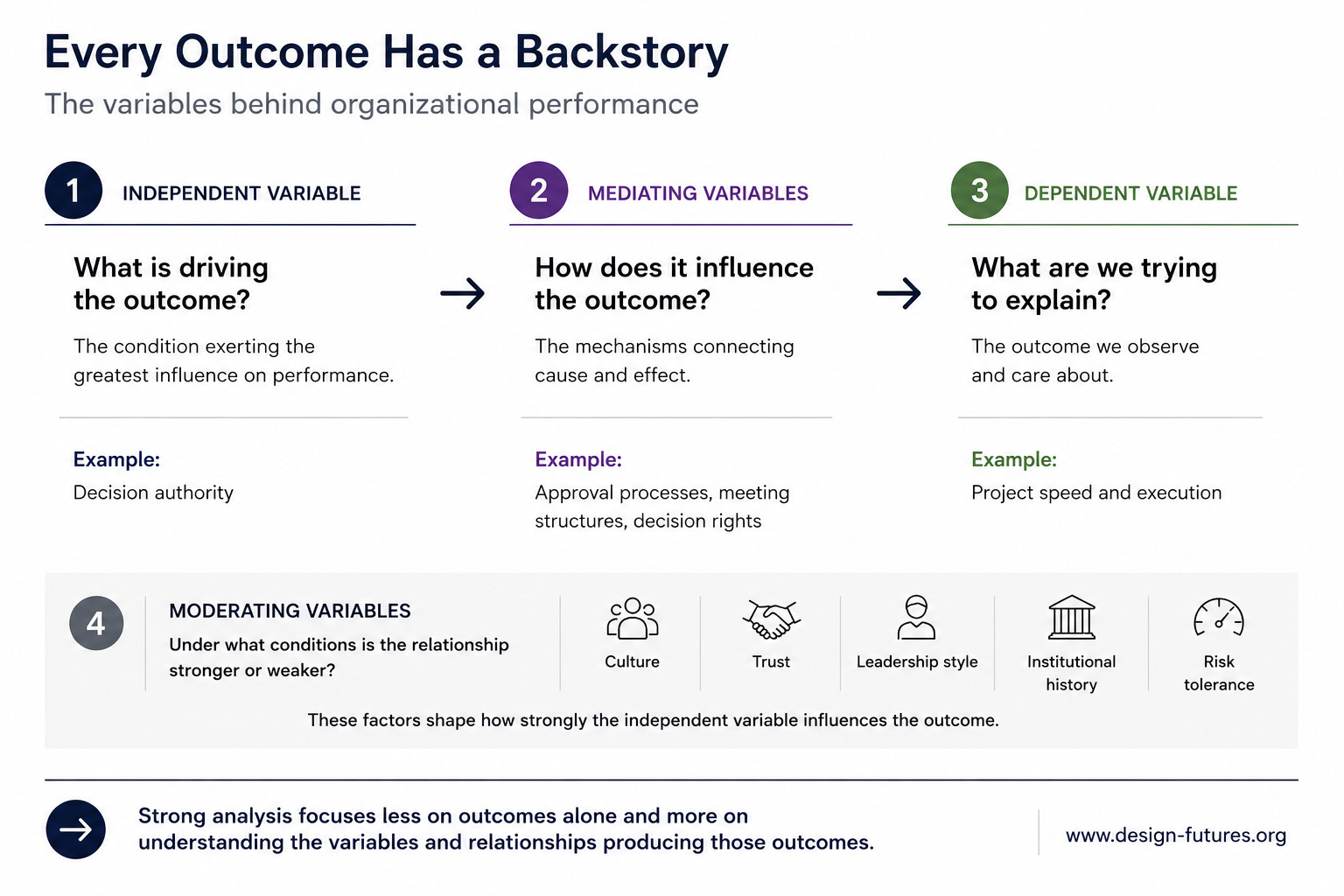
What I find helpful about thinking in terms of variables is that it encourages us to move beyond simply describing outcomes.
The breakthrough in this project did not come from talking more about speed. It came from understanding the variables shaping speed in the first place.
That distinction sits at the heart of good diagnosis. Strong analysis does not stop at describing what happened. It seeks to understand the conditions and relationships that produced it.
Learn How to See the System
The good news is that you do not need to be a consultant to think this way.
The next time a project stalls or a strategic initiative struggles to gain traction, try asking a few different questions:
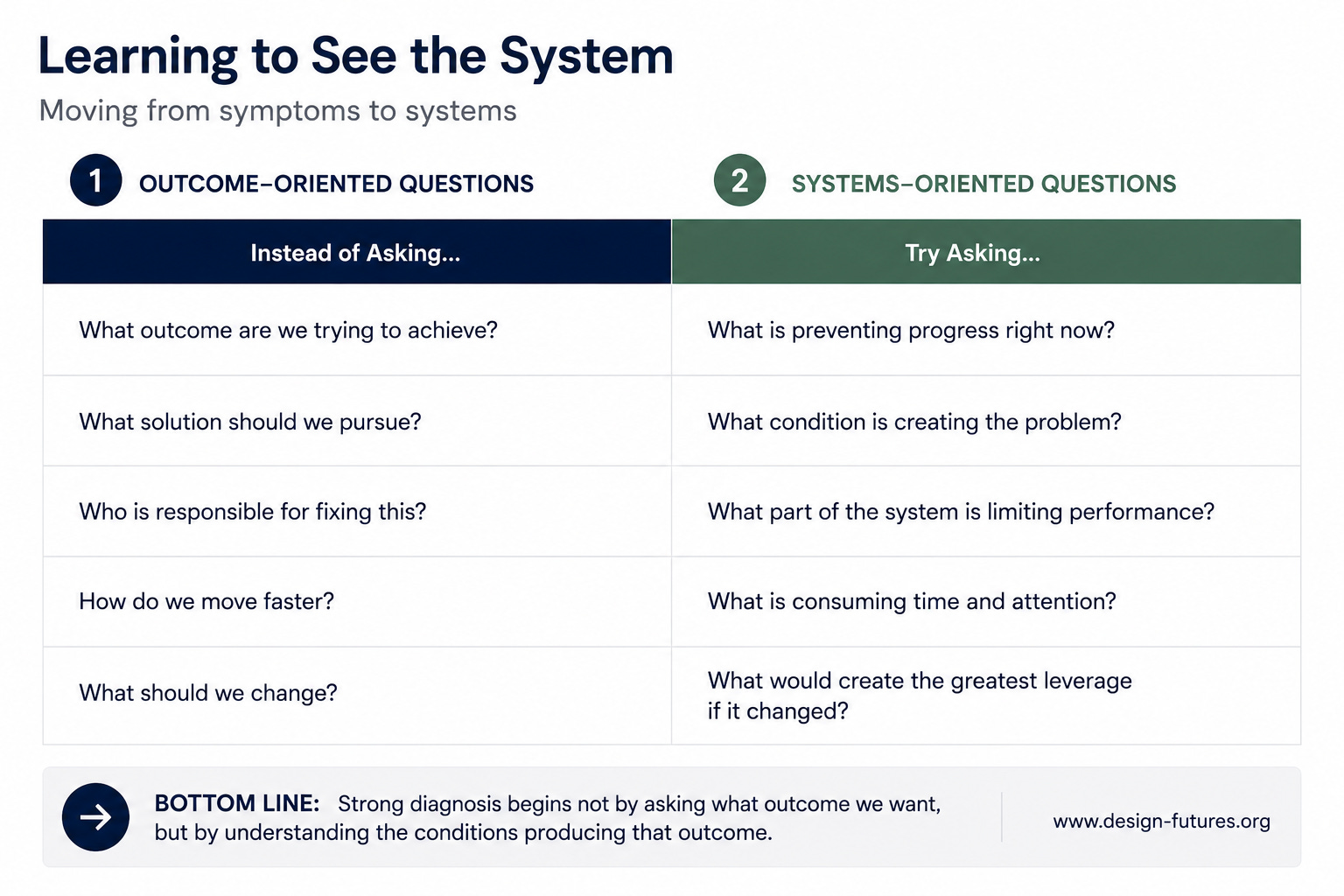
These questions do not guarantee better decisions. They do, however, encourage us to look beneath the visible surface of organizational life.
The next time you hear the same frustration repeated across different conversations, pay attention. When faculty, staff, administrators, and project leaders all describe different problems but somehow arrive at the same source of frustration, you may be getting your first glimpse of the system beneath the symptoms.
The temptation is to treat each complaint as a separate issue requiring a separate solution.
More often, they are connected.
The longer I do this work, the more convinced I become that the problem people describe is often not the problem that needs solving.
What appears to be a technology problem may actually be a governance problem.
What appears to be a staffing problem may actually be a decision-making problem.
What appears to be a time problem may actually be a leadership problem.
Every organization is a system. The challenge is identifying your constraint before chasing the wrong solution.
Sources and Helpful Resources
Donella Meadows, Thinking in Systems: A Primer
The single best introduction to systems thinking that I’ve found. Meadows provides a practical framework for understanding how systems behave, why unintended consequences emerge, and where leaders can find leverage for change.
Eliyahu M. Goldratt, The Goal
A classic business novel that introduced the Theory of Constraints to a broad audience. While written in the context of manufacturing, its central lesson—that every system has a constraint and that progress depends on identifying it—applies remarkably well to higher education and organizational leadership.
Peter Senge, The Fifth Discipline
One of the foundational texts on learning organizations and systems thinking. Senge explores how organizations can move beyond reactive problem-solving and begin understanding the deeper patterns driving performance.
Charles Goodhart, “Problems of Monetary Management” (1975)
The original source of what later became known as Goodhart’s Law: “When a measure becomes a target, it ceases to be a good measure.” While written in an economic context, the idea has profound implications for strategy, governance, and organizational performance.
Daniel Kahneman, Thinking, Fast and Slow
Although not a systems-thinking book per se, Kahneman’s work on judgment, decision-making, and cognitive bias helps explain why individuals and organizations often gravitate toward visible symptoms while overlooking underlying causes.