

Reading Future Signals
What competency-based education reveals about how higher education is beginning to change


What happens when learning moves beyond a single program, institution, or moment in time?
It’s 11 p.m. in Columbus, Ohio, and Maria is scrolling through ads for online programs. The house is quiet. Her kids are asleep. She’s still in her scrubs—too tired to change and too anxious to sleep. She’s 36, a nurse for twelve years, promoted twice, most recently to a nurse manager role that felt like a step up until her first day on the job.
When a Job Changes
Last fall, her hospital embedded patient analytics into its records system—dashboards that track outcomes and flag readmission risks. Before, Maria took care of patients; a quality team down the hall handled the data. Now she’s expected to pull reports, track metrics, and present her findings in weekly leadership meetings she never used to attend.
She still remembers the first one. She stayed up late the night before, copying numbers into a slide deck she didn’t quite understand. When her turn came, she talked too fast. She said “um” a lot. Someone asked about variance trends, and she just stared blankly at her screen.
She replayed that meeting the whole drive home. She still does.
Now, week after week, she sits in those meetings trying to say less, hoping no one asks her to explain. She knows what the data is telling her. She just doesn’t yet have the language—the fluency, the confidence, the kind of understanding that comes from real training.
What she feels isn’t frustration, exactly. It’s something far more subtle.
The fear that she’s falling behind.
The sense that everyone else “got the memo” she missed.
The creeping suspicion that maybe she’s not as good a nurse as she thought she was.
She needs to learn data visualization, maybe some basic statistics, all skills that no one discussed in her BSN program a decade ago. Granted, her hospital offers this kind of training, but it feels like an afterthought: a few videos, a quiz, a printable certificate. Nothing like the faculty mentorship she experienced in her program. That experience was transformative. It’s what made her want to be a nurse in the first place.
She would go back in a heartbeat if she could. Reconnect with faculty. Take a few classes. Maybe earn a master’s degree. But she doesn’t have the time. Or the money. Or the energy. And with two kids asleep down the hall, she isn’t even sure where to begin.
She closes her laptop. It’s 12:48 a.m. Almost two hours gone. A dozen programs bookmarked. None of them right. She can’t quite name what’s wrong. She only knows she’s doing everything she’s supposed to do—and somehow it isn’t enough.
It shouldn’t be this hard to keep learning.
Maria’s instincts are right. There’s no shortage of options—more universities, more programs, more credentials than at any point in history. But access isn’t the problem. The system itself is still built for a different era.
Higher Ed Was Built for a World That No Longer Exists
Stories like these are often framed as a lack of learner motivation (a demand-side lens) or as evidence of growing skill gaps in a changing economy (a workforce lens). But I see it another way. Maria’s story is an indicator of an educational system that no longer fits the needs of the people it’s meant to serve—a human lens.
Learning has never been more essential. What’s changed is that our educational and training systems were never designed to help people adapt when their work changes midstream like this.
We still credential at the beginning of a career, but when new demands appear, individuals like Maria are left to figure out—often alone, after midnight, with two kids asleep down the hall—what to learn, in what order, and whether any of it will even matter.
Now, I know what some of you may be thinking. Maria’s hospital offers training. Might that be a better option anyway?
Perhaps for some, but not for Maria. She did the training, and it felt disconnected and shallow. It didn’t build on what she knew. It didn’t guide her toward anything measurable. It didn’t accumulate or stack the way university credentials might.
Beyond Programs, Pathways, and Credentials
The problem is that higher education—and most workplace training, for that matter—was never designed to support learning across time and contexts. Our systems are largely episodic, driven by learner choice and agency, and in place certify that learning has occurred at specific moments in time.
When learning becomes continuous, deciding what to learn, how it fits, and whether it will count still falls to the learner—along with the uncertainty and the consequences when it doesn’t.
For decades, higher education has tried to solve this problem through a variety of academic innovations:
New online programs
Making pathways to credentials faster, cheaper, and more intuitive for working adults
Creating new types of credentials—degrees, certificates, digital, stackable, and more
Each of these innovations makes sense on its own. Together, they have dramatically expanded what’s available to working learners.
But availability isn’t the same as alignment. If we focus our innovation efforts only on what we can (and should) do within our existing systems, we miss what’s actually changing in the environment around us.
Where the Shift Is Most Visible: Competency-Based Education
The most consequential innovations underway in higher education right now don’t operate at the level of what colleges and universities offer or how they deliver it. They aren’t additive, and they don’t announce themselves in new programs, strategies, or policy papers.
They surface instead as quiet but deliberate shifts in supply and demand at the margins, where innovators are rethinking learning itself—how learning is assessed, documented, and carried forward—and, in the process, reorganizing the system around it. One of the most visible and important of these shifts is competency-based education (CBE).
At its core, CBE rests on a simple claim: time is a poor proxy for learning. Instead of asking how long students sit in a classroom, it asks what students can actually do. Progress is tied to demonstrated mastery. Learning is defined by capability, not calendars.
That shift matters. CBE opens the door for learners who already know some things and need to learn others. It makes prior experience visible and tangible in ways traditional models overlook. And it forces institutions to say—clearly, in writing, on official documents, and often uncomfortably—what exactly they expect students to learn.
CBE sits at the center of higher education’s current transition—not as a finished solution and certainly not as a passing trend, but as a pressure point that continues to test the system’s assumptions about how learning works.
CBE isn’t simply another program, pathway, or credential either. It represents a fundamental challenge to how learning is defined, measured, and accumulated over time.
In that sense, I think of CBE as one of the ways the margins have begun to talk back to, and even teach, the system. It makes visible tensions in the higher education model that have long been present but easy to ignore.
Solving for Mastery, Not Continuity
The core problem CBE is designed to solve is straightforward: time is a poor proxy for learning. Seat time tells us how long someone was present, not what they can actually do.
But as CBE expands, its natural limits come into view.
Even in its most thoughtful forms, CBE remains largely institutional in nature:
Competencies defined inside and in relation to academic programs
Assessment bounded by enrollment at a particular institution
Learning recognized while a student is present—and, as with most academic programs, harder to carry forward once the student leaves
In other words, CBE challenges the system—but largely from the inside.
Don’t read that tension as me saying there’s a flaw in the CBE itself. Read it more as a signal about the system itself and how it’s changing.
Untether learning from seat time, and a different set of questions surface—a design challenge CBE itself can’t readily solve.
How do we recognize learning across contexts, and design recognition that stays with learners in the moment and over time? But more consequentially, who carries the responsibility and risk when learning no longer fits neatly inside a single credential, institution, or workplace?
CBE makes this challenge unavoidable. But it also exposes a deeper one that higher education now confronts even within a CBE context:
If learning is becoming continuous, why does recognition of competence still behave as if it were episodic?
That gap—the space between continuous learning and episodic recognition—is where learners like Maria get stuck. And it’s where the next shift in higher education begins..
How I’ve Learned to Notice What Doesn’t Quite Fit
Earlier in my career, while working at Eduventures, I spent a lot of time immersed in the world of CBE and at the time, the field felt narrow and technical—people debating definitions of competency, talking about pacing, asking basic questions about assessment and credit equivalency.
All useful work, but largely tactical. My role was helping institutions understand the big picture around CBE, decide whether to explore it further, and figure out how to make it function inside systems that weren’t designed for it.
What I didn’t realize then was that CBE was pointing toward a much broader, more radical set of systemic changes.
The more time I spent with leaders in this field, the more the conversation drifted from pedagogy to infrastructure, not just how people learn, but where learning itself lives. Who gets to recognize learning, what happens to it when a student leaves, and whether it can be carried forward at all.
Around that time, a small but growing group of institutions was grappling with these same questions in earnest. Schools like Western Governors University, Southern New Hampshire University, the University of Wisconsin System, Capella University, and Brandman University (now UMass Global) were all wrestling with much bigger questions, like:
How to build organizational structures to support this learning model
How to assess competencies consistently and at scale
How to make the model legible to accreditors and financial aid regulators.
Seeing how some of those institutions worked from the inside was my first exposure to how important an innovation like CBE really is, but also how much strain even a well-designed implementation of CBE could place on the structures, norms, and practices around it.
Later, as my work broadened into strategy, design, and futures thinking, I began to notice the same pattern elsewhere:
The most consequential changes in higher education weren’t showing up as big breakthroughs or bold announcements. They showed up as friction. As workarounds. As moments where smart, capable people did everything right and still ran into the environmental limits.
Through it all, I learned to be wary of bold, confident predictions about the future of higher education, or CBE for that matter. Innovations of this magnitude rarely take hold as we expect. That I know for certain. But also, even the best innovations (sustaining, breakthrough, or even disruptive) still has to make sense inside the systems they depend on.
So, what happens when…
Those systems begin to strain? What do we see? What do we notice? How do we react?
Old and even new assumptions stop holding? Do we dig and fight? Give up? Move on?
Tools and technologies built for one world start to misfire in another? Does that mean they’re the wrong resources? Do we need new ones? Or is that knee-jerk response to assuming we need something new the problem?
I have no idea, which is why I recommend instead paying attention to signals of change happening with and around the innovation—not because they tell us the answer, but because they reveal what the present system can no longer sustain.
Seeing the Shift Through a Futures Lens
Futurists describe moments like this using a simple framework: the Futures Triangle—the weight of the past, the push of the present, and the pull of the future.
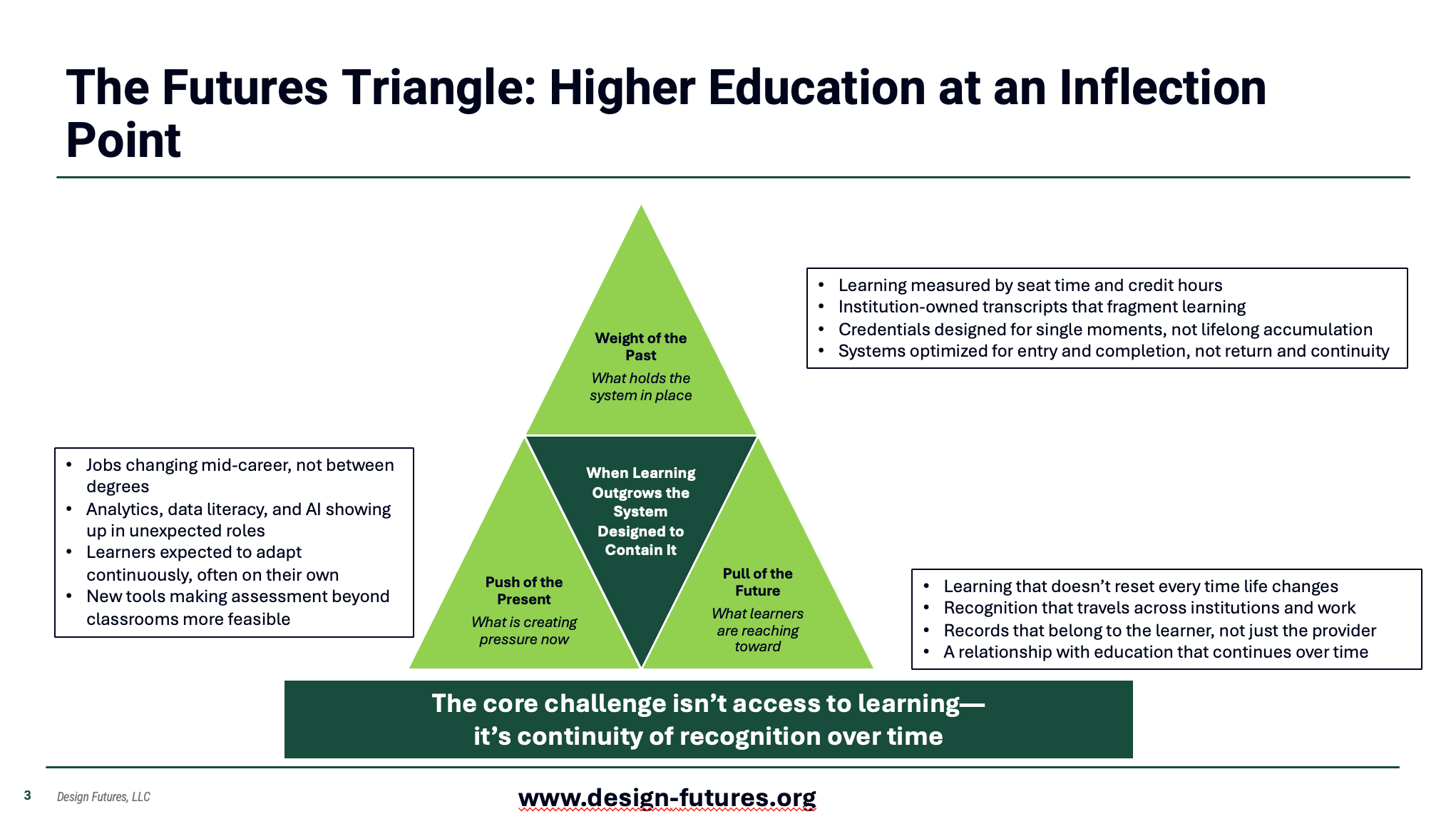
Higher education sits squarely inside that triangle:
The weight of the past is a century-old architecture built around seat time, credit hours, and institution-owned transcripts.
The push of the present is work itself—roles changing mid-career, analytics showing up in unexpected places, and new tools making different forms of assessment possible.
And the pull of the future is what Maria is searching for at 1 a.m.: learning that doesn’t reset, recognition that travels, and a relationship with education that continues instead of ending.
Seen this way, the changes underway aren’t random. They’re signals.
Three Signals Worth Paying Attention To
The weight of the past is starting to show: For more than a century, the credit hour has been the basic unit of higher education—the invisible architecture beneath financial aid, accreditation, transfer, and degree requirements. It’s so embedded that it rarely draws attention.
When architects question their own architecture, the structure is under strain: The push of the present is becoming impossible to ignore. Maria’s experience isn’t unusual. Work is changing faster than formal education can keep up. Analytics, automation, and data literacy are showing up in roles that never required them before. Responsibilities shift mid-career, not neatly between degrees.
The pull of the future is coming into focus: Most people rarely think about transcripts until they need one. But transcripts reveal how higher education is organized: learning is owned by institutions, documented in fragments, and often reset when a learner moves on. New approaches begin from a different assumption—that people learn across contexts, return to education repeatedly, and shouldn’t have to start over each time. In this future, learning accumulates. It travels. And increasingly, it belongs to the learner.
Taken together, these signals don’t point to a single reform or breakthrough. They point to a deeper shift in how learning is measured, recognized, and carried forward.
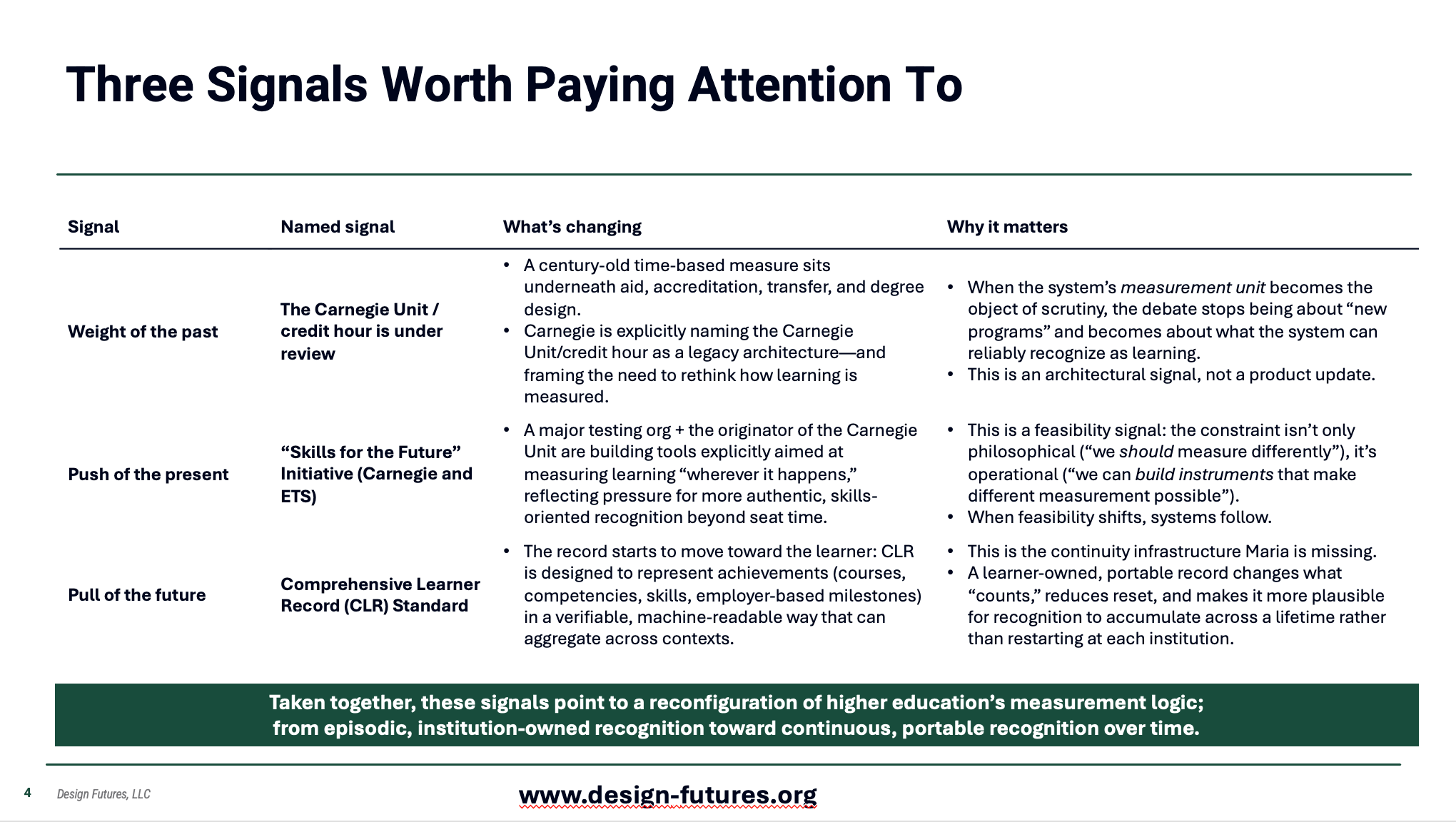
What’s unfolding here isn’t a single thing, but a slow reconfiguration of what higher education optimizes for and whom it is built to serve over time.
An Innovation Still Unfolding
These three signals come from different places—a system under strain, changing work, and new ways of documenting learning. But they point in the same direction.
Toward a system where learning is continuous, portable, and recognized wherever it happens. Not measured by time. Not confined to a single credential. Owned by the learner and sustained across a lifetime.
That’s the innovation still in development. And it’s not a new program or degree, but perhaps a new process for how learning is recognized, verified, and carried forward.
Like all good innovations, it begins at the margins, serving learners that the mainstream system struggles to support. It looks unfamiliar at first. It may not resemble higher education as we know it. But if the pattern holds, it won’t stay at the margins for long.
The Cost of Getting It Wrong
In the future these signals point toward, Maria isn’t searching alone—starting over, wondering why it’s so hard to keep learning when she’s done everything she’s supposed to do.
She has someone who stays with her: an institution or something like one, a service, maybe a product that remembers where she’s been and helps her see where she’s going. Not once. Not twice. For as long as she keeps learning.
Whatever this new infrastructure becomes, it cannot abandon quality. That’s the hardest thing to replace—and the thing universities have historically done best. Not just content, but coherence. Mentorship. Standards. Judgment. The work of helping learners understand not just what they’ve learned, but what it’s worth and how it fits.
That’s the job that’s never really been done.
And it isn’t optional anymore. As learning becomes continuous, systems built for episodic recognition create friction, doubt, and waste—not just for individuals like Maria, but for institutions trying to remain relevant. The question isn’t whether this work will happen. It’s whether higher education will help shape it—or be reshaped by it.