

Reversible by Design
Why Higher Ed Needs More Two-way Doors and Fewer Dead Ends

A few months ago, I was in a meeting with a university leadership team where the topic was—no surprise—artificial intelligence. Specifically, we were demoing a sleek new AI course-authoring platform.
The college’s chief strategy officer smiled as the demo started. “Let’s see what this thing can actually do.”
Heads nodded around the table. Some saw opportunity. Others saw risk. But mostly, people were just curious.
I certainly was.
About a minute into the demo, the room went quiet. A lot of soft clicks on keyboards and followed by a slow realization of what the tool could actually do. Then the results appeared on screen, and our quiet turned to astonishment.
The system drafted syllabi in seconds, aligned learning outcomes to accreditation standards, and produced assignments that adjusted to student profiles. It was fast, polished, and eerily competent. You could almost hear the collective gasp around the room.
By mid-afternoon, curiosity created a surprising kind of momentum. The conversation shifted from questions to possibilities, and then from possibilities to plans.
Pretty soon, all our excitement started to sound like commitment. And the commitment started to sound permanent.
But as I’ve learned, permanence in the age of AI is a strange thing to chase.
So I stepped in:
“Remember, we don’t have to treat this like a permanent decisions. Make it a reservable decision instead. Start small. Pilot it. Learn fast. And be ready to step back if it’s not the right fit.”
Because in a learning landscape shifting faster than anyone can predict, agility matters more than certainty. And the future will belong to organizations that make more room for what Jeff Bezos infamously called “two-way door decisions” that preserve flexibility when the world changes faster than our assumptions do.
What Are Two-Way Door Decisions?
Think of walking through a one-way door as a decision you can’t easily reverse. Once you walk through, you’re committed. The costs of turning back—whether financial, political, cultural, institutional, or even personal—are too high.
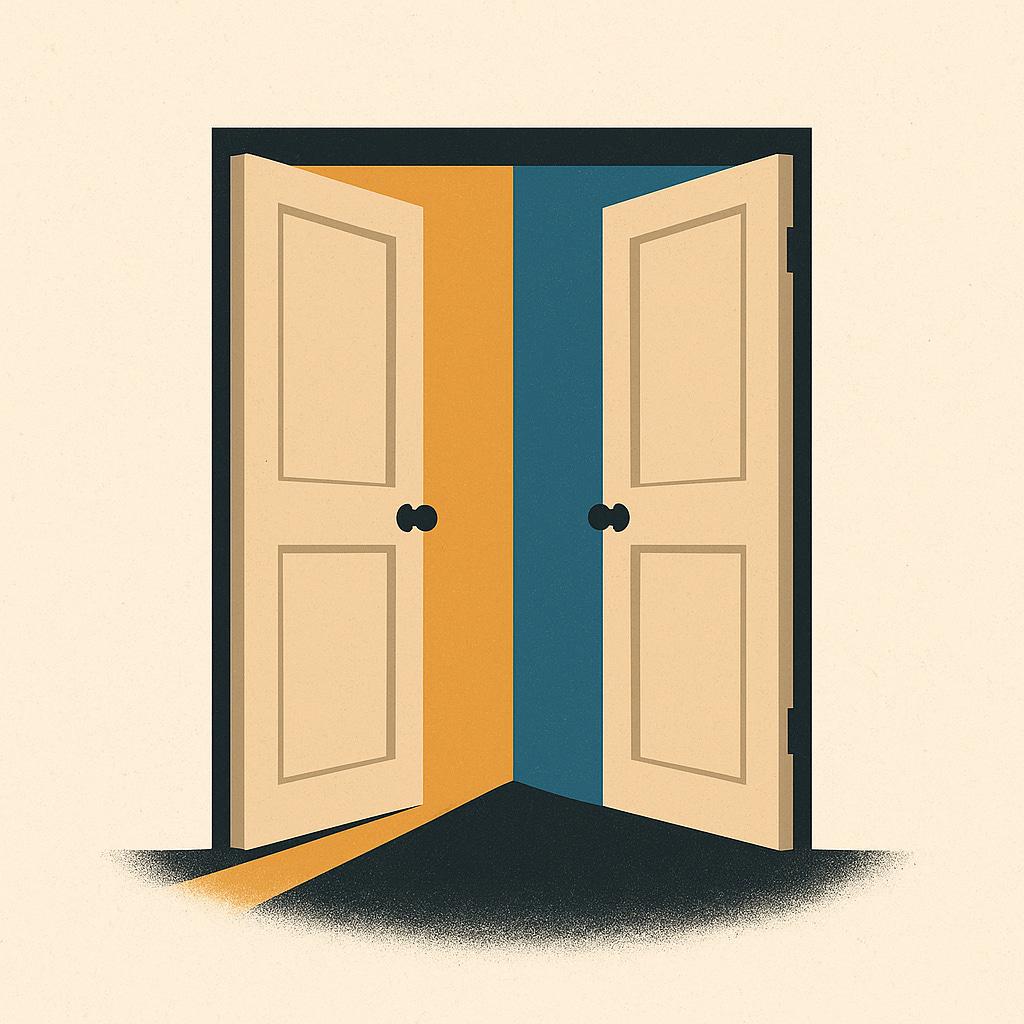
A two-way door is different. Think of it more as an experiment. You can open it, take a look around, and step back out if the view isn’t what you expected. A pilot program, a short-term partnership, a one-year contract, a prototype course. These are two-way door decisions that invite learning before commitment.
Bezos’s metaphor is simple but powerful because it makes strategy tangible. You can picture yourself standing there, hand on the handle, deciding whether to step through.
The Danger of Path Dependency
Of course, the anxiety behind that image isn’t new. Long before Silicon Valley made agility a virtue, economists were warning about what happens once you pick a path and start walking. They called it path dependency. It’s the tendency for early choices to harden into habits, systems, and sunk costs that shape every decision that follows.
Technology only makes certain paths more treacherous. Each new platform arrives with training, integrations, data models, and processes that bend the institution around it. What begins as a tool quickly becomes infrastructure; what looks like progress becomes permanence. And in higher education, where change already moves slowly, every technological decision carries the weight of years.
That’s why the metaphor of doors matters so much right now. Because in a learning landscape being reordered by technology, it’s not just about choosing the right door. It’s about making sure you can walk back through it when you need to.
In times of stability, one-way doors can make sense. Permanence gives institutions coherence. But in a world that’s shifting this fast—where AI is evolving weekly, student expectations are changing by the semester, and credentials are being reinvented in real time—permanence becomes a liability.
If higher education is going to stay relevant, it has to make much more room for two-way doors: decisions designed for learning, reversibility, and agility.
The Doors We Build
Once you start looking for one-way doors in higher education, you see them everywhere.
A gen ed redesign is a good example of a one-way door. It takes years of planning and negotiation, and once approved, it reshapes everything: faculty workloads, advising, course sequencing, accreditation, even how students talk about their education. You can’t easily walk that back.
A technology decision can be the same. Sign a long-term contract for a learning management system, and you inherit the vendor’s logic: their workflows become your workflows. Even if a better option comes along, you’re already trained, integrated, and dependent.
A capital project has similar traits. You can’t pilot a brand new building. You commit to it, fund it, fill it, and then live with it for decades, whether or not student demand ever justifies the space.
But there are other doors, smaller and lighter, that open both ways.
A microcredential pilot is a two-way door. So is a short-term partnership with an employer or a faculty-led experiment with AI in the classroom. You can test, learn, and adapt before the stakes get too high.
Even something as simple as a one-year contract instead of a five-year license can turn a one-way door into a two-way one. It’s not about avoiding commitment; it’s about designing decisions that invite learning.
The future of higher education isn’t about locking in—it’s about learning faster. The institutions that thrive aren’t the ones that build the most elaborate doors. They’re the ones that leave themselves room to step back through.
When Our Paths Become Dangerous
The problem isn’t that higher education doesn’t know how to open two-way doors. It’s that our institutional systems keep closing them too soon.
A small pilot turns into a standing committee. A one-year trial becomes a permanent line item. A flexible partnership gets codified into policy. Even experiments that start as learning exercises often end up formalized before anyone has had time to really learn from them.
It’s not malice. It’s just our culture. Institutions reward commitment. They value permanence. They trust permanence.
More concretely, the task forces and committees we form? They can’t go on forever. They have goals and a need to create closure.
Boards want certainty. Accreditors want evidence of stability. Every decision moves toward the safety of the one-way door, because stability feels like progress.
But that instinct comes at a cost. When the world changes—and it always does—those same systems that once provided stability start to slow you down. The very structures built to protect the institution begin to trap it.
That’s the dangerous part. The doors don’t close overnight. They close quietly, one approval at a time, until you realize the institution isn’t learning anymore. It’s just defending the decisions it’s already made.
Why I Love Two-Way Doors
Two-way doors aren’t hypothetical. They’re how organizations learn when the world around them is changing faster than they can plan.
A pilot course, a short-form credential, a one-year partnership, a limited faculty experiment with AI. These can just as easily be seen as small, reversible moves that generate insight without locking anyone in. Like creating space for discovery, for trial and error, for listening to what students and faculty actually experience before turning an experiment into a system.
Most universities already run pilots, but they don’t always protect them as two-way doors. The impulse to formalize—to declare success, scale up, and make permanent—kicks in too quickly. Before long, the experiment becomes another one-way door, and the chance to learn from it disappears.
That’s what agility looks like when it’s working: not endless experimentation, but a discipline of keeping doors open long enough to learn what’s on the other side.
Try This Next Time
Before your next big decision, pause and ask three questions:
Is this a one-way door or a two-way door?
Can you change your mind later? If yes, it’s probably a two-way door. So move fast and learn. If you get this wrong, how hard is it to undo? If the answer is very, it’s a one-way door. Slow down before you decide!
Can we design this to be reversible?
Could you frame it as a pilot? Add a exit clause? Limit the scope or timeline? Remember, most one-way doors start out as two-way ones. You just have to protect the exit before you walk through.
What are we learning by doing this?
The goal isn’t just to decide but to learn. If you can’t clearly say what you expect to learn, you’re probably not opening a two-way door.
Institutions that thrive in the next decade won’t be the ones that find the perfect solutions. They’ll be the ones that keep the doors open long enough to adapt when the world changes again.