

The Interim Problem
The Hidden Cost of Temporary Leadership in Higher Education


By fall 2024, The Wall Street Journal reported that more than three dozen universities, including Columbia, Cornell, and Penn, were simultaneously being led by interim presidents.
The email from the board chair arrived on a Tuesday morning. Three paragraphs, carefully worded: the university’s beloved longtime president would be stepping down at the end of the semester. A national search would commence immediately. A well-liked former dean with no aspirations for a permanent role would serve as “interim.”
By lunchtime, the entire campus was reading between the lines:
In the provost’s office, the conversation turned to a major online learning initiative that was mid-implementation and suddenly had no executive champion. “Do we keep going?” someone asked. No one had a good answer.
In enrollment management, a proposed investment in international recruitment needed budget approval from the president’s cabinet, but that now felt somehow provisional. A VP saved the proposal and closed the laptop.
Among the faculty senate, a deeply divisive tenure case that had been building for months had emerged. The Senate leadership had carefully built a coalition and consulted legal counsel, but a decision this charged required visible backing from the president’s office. It needed a permanent leader with social capital willing to absorb the political fallout. Without that, the coalition fractured. No one formally tabled the matter. People just stopped returning emails.
In student affairs, a dean fielded questions from her staff about two vacant director positions the president had given her permission to fill. “Are we still hiring?” someone asked. “I don’t know,” she said, and meant it.
On the Job, for Now
The interim president, for his part, stayed in his own lane, doing exactly what the board asked him to do. “My job,” he told the campus in his first address, “is to keep this institution running smoothly until your next president arrives.” People appreciated his humility, but they also walked out asking, "So who’s actually making decisions right now?”
Across dozens of offices and conference rooms, the same thing started happening simultaneously: people pulling back, slowing down, waiting for clarity that wouldn’t arrive for months.
Of course, the institution hadn’t stopped. But it did start to drift.
The New Normal (and a Burden)
When I work with colleges and universities navigating interim leadership (presidents, provosts, CFOs, VPs, etc.), few people describe their experience in neat organizational terms. They describe it more as a burden. Not because a high-ranking leader left, but because the momentum and shared purpose that left with them hasn’t yet been replaced by anything.
That burden is real. The feeling that your work was building toward something. That it served a vision. That someone at the top understood what you were trying to do and had your back. During an interim, that feeling disappears, and what replaces it is a slow, corrosive drift.
People keep showing up. People keep doing the job. But the connective tissue that once made their efforts feel like part of a larger whole stalls out.
You’re no longer building. You’re maintaining, for a time. And when an entire institution shifts into maintenance mode, let’s be honest about what actually happens:
Proposals don’t get written.
Committees stop meeting.
Important conversations stop happening because no one is sure they’re worth having right now.
I hate seeing institutions and leaders in that state. And I am convinced that boards, search committees, and senior leaders consistently underestimate the damage it causes. At best, they think about managing operational risks through a transition. What they almost never account for is the toll this takes on people.
The interim problem has a deep cultural cost: a slow demoralization that settles across an institution when no one is sure the work they’re doing matters at the moment. That kind of damage accumulates quickly, and it takes much longer to repair—even after the permanent role has been filled.
How Universities Actually Make Decisions
There’s a reason this kind of demoralization happens. And it has less to do with the people involved than with the way universities have historically operated, for better or worse.
In 1972, Michael Cohen, James March, and Johan Olsen published what would become one of the most cited frameworks in organizational theory: the Garbage Can Model of decision-making. I love this theory, as anyone who regularly reads my Substack knows by now.
The model described how organizations, especially colleges and universities, which they called “organized anarchies,” actually make progress day after day.
The model’s core insight is disarmingly simple:
In organizations where goals are ambiguous, technology is unclear, and participation is fluid, decisions don’t happen through rational analysis. Instead, four independent streams float through the organization: problems, solutions, participants, and choice opportunities.
Progress happens when all four streams collide at the right moment. Not because someone designed the collision, but because the timing just happened to work.
If that sounds chaotic, it’s because it is. But here’s the thing Cohen and March understood about how colleges and universities work: this isn’t a dysfunction; it’s just how things work.
The garbage can isn’t a sign of a broken system. It is the system, whether we acknowledge it or not.
The Garbage Can In Action
Now imagine what happens to that system during a big leadership transition, like the one above.
Under normal conditions, the president meets with people weekly, creating predictable opportunities for choice. Key leaders show up consistently, which stabilizes participation. Strategic priorities, however loosely defined, create a gravitational pull that connects certain problems to certain solutions.
An interim period disrupts all of this at once.
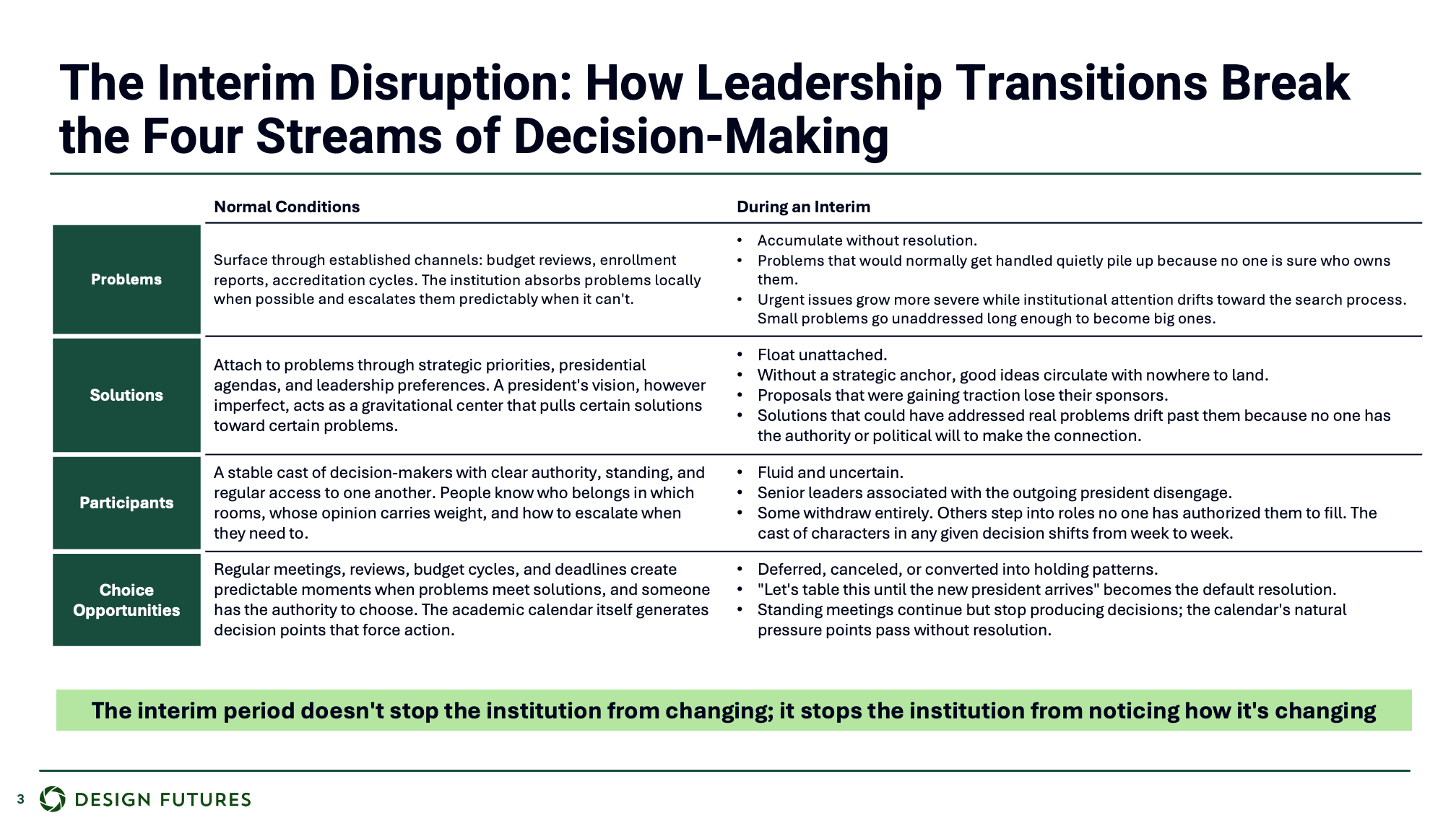
During the interim period, collisions occur less frequently. Problems accumulate, solutions lose their sponsors, capable people withdraw, and decisions stall. And the longer it persists, the more deferred complexity the next president inherits on day one.
Streams don’t stop flowing during an interim period. The institution just loses its ability to bring them together consistently and at once.
When the Interim Problem Does Real Damage
Not all interim periods produce the same degree of damage. But the factors that determine how bad it gets are mostly outside anyone’s control, and they compound in ways that no one anticipates until it’s too late:
Duration is the silent killer. A three-month interim might keep the streams in motion and still manageable. An eighteen-month national search can hollow them. Key participants (the ones who manage all these problems, solutions, and choice opportunities) don’t wait around. Your best enrollment strategist takes a call from a headhunter. Your most effective dean, the one who was holding three garbage cans together through sheer force of will, decides this is the right time to move on. Accreditation timelines don’t pause because your leadership is temporary. Grant deadlines don’t move. Every month without direction is a month where the institution falls further behind in ways that won’t show up in the data for another two years.
The middle layer either saves you or breaks. When the provost, deans, and senior directors are experienced and politically secure, they can absorb the vacuum above them and keep the streams colliding. But when they’re not, when they’re new, acting, or unsure whether they’ll survive the transition themselves, the drift doesn’t trickle down. It cascades. You end up with an interim president, an acting provost, and ineffective teams all waiting for someone else to go first. No one does. Decisions that should take a week take a semester. Problems that could have been contained at the department level metastasize into institutional crises because no one felt authorized to act.
Culture determines the floor. At a university with deep traditions of shared governance, the faculty senate may keep functioning through sheer force of habit. The institution drifts, but it drifts slowly. At a more top-down institution, the loss of a single leader can paralyze the entire system overnight. And at institutions where trust was already thin, where the outgoing leader left under difficult circumstances or where the board’s credibility is in question, the interim period doesn’t just stall progress. It surfaces every unresolved grievance the previous administration managed to keep below the surface. People don’t just stop making decisions. They start relitigating old ones.
Here’s what makes all of this so dangerous: none of it is visible from the outside. The board sees a campus that looks calm. Enrollment is steady this semester. The budget is balanced. No one is in open revolt. The interim is doing their job. But underneath that calm, the institution is quietly losing the people, the momentum, and the decision-making muscle it will need to function when the new leader finally arrives. And by then, the damage is already done.
Six Ways to Keep the Institution Moving
The challenge facing people during interim periods is structural: the institution’s normal decision-making mechanisms have been disrupted, but the need for decisions hasn’t slowed. If that’s you, you need ways to manage yourself, your team, and your institution through it.
Here's what you can do right now:
Name the problem. The single most useful thing anyone can do during an interim period is acknowledge what everyone already knows: we are in a transition, it is uncomfortable, and pretending otherwise doesn’t help. An unspoken agreement governs most interim periods, an agreement to act as if everything is normal. It isn’t. Saying so doesn’t create panic. It creates permission to be honest about what’s hard.
Surface issues instead of waiting. The interim period creates a bystander effect where everyone assumes someone else is tracking the issue. Often, no one is. If you see a problem worsening, enrollment trending the wrong way, a compliance deadline approaching, or a key position vacant, be the person who says it out loud. In a meeting, in a memo, in a hallway conversation with the right person.
Keep good ideas coming. If you were working on a proposal or initiative before the interim period, don’t shelve it. Document where it stands and why it matters. Solutions that disappear during an interim don’t always get revisited later. They just get forgotten. Make sure your work is part of the institutional record that gets handed to the incoming leader.
Stay in the room. The most corrosive thing about an interim period is the slow withdrawal of capable people from the places where decisions get made. If you’ve been part of a committee, a working group, or a leadership conversation, keep showing up. Your presence signals to others that the work still matters. And if you notice colleagues pulling back, reach out. Sometimes all it takes is one person saying, “We still need to have this conversation.”
Push for decisions, not deferrals. When you’re in a meeting that’s about to end with “let’s revisit this when a permanent leader is hired,” ask the honest question: does this actually need to wait? People defer many decisions during an interim that are perfectly reversible, decisions that don’t require presidential involvement at all. Most of what people table falls into this category, and everyone in the room knows it.
Document everything. The new leader will (hopefully) arrive with energy and ideas, but very little context. One of the most generous things you can offer them is a clear, honest record of where things stand: a working map of which problems are urgent, which solutions are on the table, which decisions were deferred, and why.
The Real Risk: Not Getting Ahead of Ourselves
There’s a line that gets repeated during every interim period, usually by board members or senior faculty: “Let’s not get ahead of ourselves.” It sounds prudent. But the hidden assumption is that the biggest risk is action, that moving forward without the permanent leader is more dangerous than standing still.
In my experience, the opposite is almost always true. The institutions that struggle most after a leadership transition aren’t the ones that made too many decisions during the interim. They’re the ones who made too few.
A new leader arrives only to find a garbage can so full of unresolved problems, abandoned solutions, and deferred choices that their entire first year gets spent sorting through the wreckage. That’s a much harder thing to recover from than a decision they would have made differently.
If you’re leading during an interim period right now, with or without the title, here’s what I’d encourage you to remember:
The institution is still changing, whether anyone is steering it or not.
Your willingness to make decisions, surface problems, and stay in the room is the only thing standing between drift and direction.
No one may thank you for it. The new leader may arrive with their own vision and quietly set aside everything you worked to preserve. The board may never acknowledge what you held together. Do it anyway.
The institution on the other side of this transition will be a little more whole than it would have been without you. That's not a reward. It's the job. And right now, it's yours.
All of this - and then when they do seat new leadership, they’re not staying as long as they used to!